DayThemIconLogo
DayThemTextLogoDayThemSpecificTextLogo
Người học
Tài khoản người họcĐăng nhập ngay
Tổng hợp đề thi thử môn Tiếng Anh có lời giải chi tiết (Đề số 3)

Tổng hợp đề thi thử môn Tiếng Anh có lời giải chi tiết (Đề số 3)

Trắc nghiệm tiếng anh Thi tốt nghiệp

Tổng câu hỏi:48
Thời gian làm: 01:00:00

Tổng câu hỏi: 48

Thời gian làm: 01:00:00

L
Câu 1 (0.21đ)

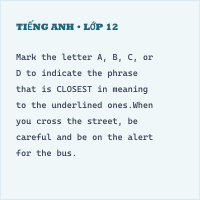
Mark the letter A, B, C, or D to indicate the phrase that is CLOSEST in meaning to the underlined ones.

When you cross the street, be careful and be on the alert for the bus.

  • A.

    Look for

  • B.

    watch out for

  • C.

    search for

  • D.

    watch for

Chưa có lời giải

Câu 2 (0.21đ)

Read the following passage on transport, and mark the letter A, B, C, or D on your answer sheet to indicate the correct answer to each of the questions from 1 to 8.

(1) It was the first photograph that I had ever seen, and it fascinated me. I can remember holding it at every angle in order to catch the flickering light from the oil lamp on the dresser. The man in the photograph was unsmiling, but his eyes were kind. I had never met him, but I felt that I knew him. One evening when I was looking at the photograph, as I always did before I went to sleep, I noticed a shadow across the man’s thin face. I moved the photograph so that the shadow lay perfectly around his hollow cheecks. How different he looked!

(2) That night I could not sleep, thinking about the letter that I would write. First, I would tell him that I was eleven years old, and that if he had a little girl my age, she could write to me instead of him. I knew that he was a very busy man. Then I would explain to him the real purpose of my letter. I would tell him how wonderful he looked with the shadow that I had seen across his photograph, and I would most carefully suggest that he grow whiskers.

(3) Four months later when I met him at the train station near my home in Westfield, New York, he was wearing a full beard. He was so much taller than I had imagined from my tiny photograph.

(4) “Ladies and gentlemen,” he said, “I have no speech to make and no time to make it in. I appear before you that I may see you and that you may see me.” Then he picked me right up and kissed me on both cheeks. The whiskers scratched. “Do you think I look better, my little friend?” he asked me.

(5) My name is Grace Bedell, and the man in the photograph was Abraham Lincoln.

What did Grace Bedell do every night before she went to sleep?

  • A.

    She wrote letters.

  • B.

    She looked at the photograph.

  • C.

    She made shadow figures on the wall.

  • D.

    She read stories.

Chưa có lời giải

Câu 3 (0.21đ)

Read the following passage and mark the letter A, B, C or D on you answer sheet to indicate the correct word or phrase that best fits each of the numbered blanks from 1 to 5.

How men first learnt to (1) ........ words is unknown; in other words, the origin of language is a mystery. All we really know is that men, unlike animals, (2) ............ invented certain sounds to express thoughts and feelings, actions and things so that they could communicate with each other; and that later they agreed (3) ........... certain signs, called letters, which could be combined to represent those sounds, and which could be written down. These sounds, (4) .......... spoken or written in letters, are called words. Great writers are those who not only have great thoughts but also express these thoughts in words that a peal powerfully to our minds and emotions. This charming and telling use of words is what we call literary (5) ........... Above all, the real poet is a master of words.

Điền ô số 5

  • A.

    prose

  • B.

    work

  • C.

    form

  • D.

    style

Chưa có lời giải

Câu 4 (0.21đ)

Read the following passage on transport, and mark the letter A, B, C, or D on your answer sheet to indicate the correct answer to each of the questions from 1 to 8.

(1) It was the first photograph that I had ever seen, and it fascinated me. I can remember holding it at every angle in order to catch the flickering light from the oil lamp on the dresser. The man in the photograph was unsmiling, but his eyes were kind. I had never met him, but I felt that I knew him. One evening when I was looking at the photograph, as I always did before I went to sleep, I noticed a shadow across the man’s thin face. I moved the photograph so that the shadow lay perfectly around his hollow cheecks. How different he looked!

(2) That night I could not sleep, thinking about the letter that I would write. First, I would tell him that I was eleven years old, and that if he had a little girl my age, she could write to me instead of him. I knew that he was a very busy man. Then I would explain to him the real purpose of my letter. I would tell him how wonderful he looked with the shadow that I had seen across his photograph, and I would most carefully suggest that he grow whiskers.

(3) Four months later when I met him at the train station near my home in Westfield, New York, he was wearing a full beard. He was so much taller than I had imagined from my tiny photograph.

(4) “Ladies and gentlemen,” he said, “I have no speech to make and no time to make it in. I appear before you that I may see you and that you may see me.” Then he picked me right up and kissed me on both cheeks. The whiskers scratched. “Do you think I look better, my little friend?” he asked me.

(5) My name is Grace Bedell, and the man in the photograph was Abraham Lincoln.

From this passage, it may be inferred that

  • A.

    Grace Bedell was the only one at the train station when Lincoln stopped at Westfield

  • B.

    There were many people waiting for Lincoln to arrive on the train

  • C.

    Lincoln made a long speech at the station in Westfield

  • D.

    Lincoln was offended by the letter

Chưa có lời giải

Câu 5 (0.21đ)

Mark the letter A, B, C or D on your answer sheet to indicate the underlined part that needs correction in each of the following questions.

The skin receives nearly (A) the (B) third of the blood pumped out (C) by (D) the heart.

  • A.

    nearly

  • B.

    the

  • C.

    pumped out

  • D.

    by

Chưa có lời giải

Câu 6 (0.21đ)

Mark the letter A, B, C, or D on your answer sheet to indicate sentence that is similar in meaning to the given one

"If I were you, I would take the job," said my room-mate.

  • A.

    My room-mate was thinking about taking the job.

  • B.

    My room-mate advised me to take the job.

  • C.

    My room-mate introduced the idea of taking the job to me.

  • D.

    My room-mate insisted on taking the job for me.

Chưa có lời giải

Câu 7 (0.21đ)

Mark the letter A, B, C, or D on your answer sheet to indicate sentence that is similar in meaning to the given one

"Cigarette?" he asked. "No, thanks." I said.

  • A.

    He asked for a cigarette, and I immediately refused.

  • B.

    He mentioned a cigarette, so I thanked him.

  • C.

    He offered me a cigarette, but I promptly declined.

  • D.

    He asked if I was smoking, and I denied at once.

Chưa có lời giải

Câu 8 (0.21đ)

Mark the letter A, B, C or D on your answer sheet to indicate the underlined part that needs correction in each of the following questions.

Salt was once (A) too (B) scare and (C) precious that it was used as money. (D)

  • A.

    once

  • B.

    too

  • C.

    and

  • D.

    as money

Chưa có lời giải

Câu 9 (0.21đ)

Mark the letter A, B, C or D on your answer sheet to indicate the word that differs from the other three in the position of primary stress in each of the following questions.

  • A.

    mysterious

  • B.

    historical

  • C.

    particular

  • D.

    heritage

Chưa có lời giải

Câu 10 (0.21đ)

Mark the letter A, B, C or D on your answer sheet to indicate the correct answer to each of the following questions.

He ……………………. alone a month ago, and …………………… of since.

  • A.

    set off/hasn’t been heard

  • B.

    setted off/hasn’t heard

  • C.

    set on/hasn’t heard

  • D.

    setted on/hadn’t been heard

Chưa có lời giải

Câu 11 (0.21đ)

Read the following passage on transport, and mark the letter A, B, C, or D on your answer sheet to indicate the correct answer to each of the questions from 1 to 8.

(1) It was the first photograph that I had ever seen, and it fascinated me. I can remember holding it at every angle in order to catch the flickering light from the oil lamp on the dresser. The man in the photograph was unsmiling, but his eyes were kind. I had never met him, but I felt that I knew him. One evening when I was looking at the photograph, as I always did before I went to sleep, I noticed a shadow across the man’s thin face. I moved the photograph so that the shadow lay perfectly around his hollow cheecks. How different he looked!

(2) That night I could not sleep, thinking about the letter that I would write. First, I would tell him that I was eleven years old, and that if he had a little girl my age, she could write to me instead of him. I knew that he was a very busy man. Then I would explain to him the real purpose of my letter. I would tell him how wonderful he looked with the shadow that I had seen across his photograph, and I would most carefully suggest that he grow whiskers.

(3) Four months later when I met him at the train station near my home in Westfield, New York, he was wearing a full beard. He was so much taller than I had imagined from my tiny photograph.

(4) “Ladies and gentlemen,” he said, “I have no speech to make and no time to make it in. I appear before you that I may see you and that you may see me.” Then he picked me right up and kissed me on both cheeks. The whiskers scratched. “Do you think I look better, my little friend?” he asked me.

(5) My name is Grace Bedell, and the man in the photograph was Abraham Lincoln.

The word “fascinated” in paragraph 1 could best be replaced by

  • A.

    interested

  • B.

    frightened

  • C.

    confused

  • D.

    disgusted

Chưa có lời giải

Câu 12 (0.21đ)

Read the following passage on transport, and mark the letter A, B, C, or D on your answer sheet to indicate the correct answer to each of the questions from 1 to 8.

(1) It was the first photograph that I had ever seen, and it fascinated me. I can remember holding it at every angle in order to catch the flickering light from the oil lamp on the dresser. The man in the photograph was unsmiling, but his eyes were kind. I had never met him, but I felt that I knew him. One evening when I was looking at the photograph, as I always did before I went to sleep, I noticed a shadow across the man’s thin face. I moved the photograph so that the shadow lay perfectly around his hollow cheecks. How different he looked!

(2) That night I could not sleep, thinking about the letter that I would write. First, I would tell him that I was eleven years old, and that if he had a little girl my age, she could write to me instead of him. I knew that he was a very busy man. Then I would explain to him the real purpose of my letter. I would tell him how wonderful he looked with the shadow that I had seen across his photograph, and I would most carefully suggest that he grow whiskers.

(3) Four months later when I met him at the train station near my home in Westfield, New York, he was wearing a full beard. He was so much taller than I had imagined from my tiny photograph.

(4) “Ladies and gentlemen,” he said, “I have no speech to make and no time to make it in. I appear before you that I may see you and that you may see me.” Then he picked me right up and kissed me on both cheeks. The whiskers scratched. “Do you think I look better, my little friend?” he asked me.

(5) My name is Grace Bedell, and the man in the photograph was Abraham Lincoln.

What is the author’s main purpose in the passage?

  • A.

    To explain how Grace Bedell took a photograph of Abraham Lincoln

  • B.

    To explain why Abraham Lincoln wore a beard

  • C.

    To explain why the first photographs were significant in American life

  • D.

    To explain why Westfield is an important city

Chưa có lời giải

Câu 13 (0.21đ)

Mark the letter A, B, C or D on your answer sheet to indicate the correct answer to each of the following questions.

Are there any household chores for …………………. men are better …………….. than women?

  • A.

    whose/suited

  • B.

    which/suit

  • C.

    that/suit

  • D.

    which/suited

Chưa có lời giải

Câu 14 (0.21đ)

Read the following passage on transport, and mark the letter A, B, C, or D on your answer sheet to indicate the correct answer to each of the questions from 1 to 8.

(1) It was the first photograph that I had ever seen, and it fascinated me. I can remember holding it at every angle in order to catch the flickering light from the oil lamp on the dresser. The man in the photograph was unsmiling, but his eyes were kind. I had never met him, but I felt that I knew him. One evening when I was looking at the photograph, as I always did before I went to sleep, I noticed a shadow across the man’s thin face. I moved the photograph so that the shadow lay perfectly around his hollow cheecks. How different he looked!

(2) That night I could not sleep, thinking about the letter that I would write. First, I would tell him that I was eleven years old, and that if he had a little girl my age, she could write to me instead of him. I knew that he was a very busy man. Then I would explain to him the real purpose of my letter. I would tell him how wonderful he looked with the shadow that I had seen across his photograph, and I would most carefully suggest that he grow whiskers.

(3) Four months later when I met him at the train station near my home in Westfield, New York, he was wearing a full beard. He was so much taller than I had imagined from my tiny photograph.

(4) “Ladies and gentlemen,” he said, “I have no speech to make and no time to make it in. I appear before you that I may see you and that you may see me.” Then he picked me right up and kissed me on both cheeks. The whiskers scratched. “Do you think I look better, my little friend?” he asked me.

(5) My name is Grace Bedell, and the man in the photograph was Abraham Lincoln.

The word “it” in paragraph 4 refers to

  • A.

    Time

  • B.

    Speech

  • C.

    Photograph

  • D.

    Station

Chưa có lời giải

Câu 15 (0.21đ)

Mark the letter A, B, C or D on your answer sheet to indicate the word whose underlined part differs from the other three in pronunciation in each of the following questions.

  • A.

    university

  • B.

    understand

  • C.

    discussion

  • D.

    industrial

Chưa có lời giải

Câu 16 (0.21đ)

Mark the letter A, B, C or D on your answer sheet to indicate the correct answer to each of the following questions.

Beaches were ……………….. as police searched for canisters of toxic waste from the damaged ship.

  • A.

    sealed off

  • B.

    cut off

  • C.

    washed up

  • D.

    kept out

Chưa có lời giải

Câu 17 (0.21đ)

Mark the letter A, B, C or D on your answer sheet to indicate the correct answer to each of the following questions.

Too many factories dispose ……………… their waste by pumping it into rivers and the sea.

  • A.

    out

  • B.

    of

  • C.

    away

  • D.

    off

Chưa có lời giải

Câu 18 (0.21đ)

Read the following passage and mark the letter A, B, C or D on you answer sheet to indicate the correct word or phrase that best fits each of the numbered blanks from 1 to 5.

How men first learnt to (1) ........ words is unknown; in other words, the origin of language is a mystery. All we really know is that men, unlike animals, (2) ............ invented certain sounds to express thoughts and feelings, actions and things so that they could communicate with each other; and that later they agreed (3) ........... certain signs, called letters, which could be combined to represent those sounds, and which could be written down. These sounds, (4) .......... spoken or written in letters, are called words. Great writers are those who not only have great thoughts but also express these thoughts in words that a peal powerfully to our minds and emotions. This charming and telling use of words is what we call literary (5) ........... Above all, the real poet is a master of words.

Điền ô số 4

  • A.

    if

  • B.

    however

  • C.

    whether

  • D.

    though

Chưa có lời giải

Câu 19 (0.21đ)

Mark the letter A, B, C or D on your answer sheet to indicate the correct answer to each of the following questions.

I am going to the dentist’s tomorrow. I hope I don’t need to ………………….

  • A.

    have anything done

  • B.

    have nothing done

  • C.

    be done anything

  • D.

    get him do anything

Chưa có lời giải

Câu 20 (0.21đ)

Read the following passage on transport, and mark the letter A, B, C, or D on your answer sheet to indicate the correct answer to each of the questions from 1 to 7.

(1) The protozoans, minute, aquatic creatures each of which consists of a single cell of protoplasm, constitute a classification of the most primitive forms of animal life. They are fantastically diverse, but three major groups may be identified on the basis of their motility. The Mastigophora have one or more long tails, which they use to project themselves forward. The Ciliata, which use the same basic means for locomotion as the Mastigophora, have a larger number of short tails. The Sarcodina, which include amoebae, float or row themselves about on their crusted bodies.

(2) In addition to their form of movement, several other features discriminate among the three groups of protozoans. For example, at least two nuclei per cell have been identified in the Ciliata, usually a large nucleus that regulates growth but decomposes during reproduction, and a smaller one that contains the genetic code necessary to generate the large nucleus.

(3) Protozoans are considered animals because, unlike pigmented plants to which some protozoans are otherwise almost identical, they do not live on simple organic compounds. Their cell demonstrates all of the major characteristics of the cells of higher animals.

(4) Many species of protozoans collect into colonies, physically connected to each other and responding uniformly to outside stimulae. Current research into this phenomenon, along with investigations carried out with advanced microscopes may necessitate a redefinition of what constitutes protozoans, even calling into question the basic premise that they have only one cell. Nevertheless, with the current data available, almost 40,000 species of protozoans have been identified. No doubt, as the technology improves our methods of observation, better models of classification will be proposed.

The word “they” in paragraph 3 refers to

  • A.

    protozoans

  • B.

    microscopes

  • C.

    investigations

  • D.

    colonies

Chưa có lời giải

Câu 21 (0.21đ)

Read the following passage and mark the letter A, B, C or D on you answer sheet to indicate the correct word or phrase that best fits each of the numbered blanks from 1 to 5.

How men first learnt to (1) ........ words is unknown; in other words, the origin of language is a mystery. All we really know is that men, unlike animals, (2) ............ invented certain sounds to express thoughts and feelings, actions and things so that they could communicate with each other; and that later they agreed (3) ........... certain signs, called letters, which could be combined to represent those sounds, and which could be written down. These sounds, (4) .......... spoken or written in letters, are called words. Great writers are those who not only have great thoughts but also express these thoughts in words that a peal powerfully to our minds and emotions. This charming and telling use of words is what we call literary (5) ........... Above all, the real poet is a master of words.

Điền ô số 2

  • A.

    somehow

  • B.

    however

  • C.

    somewhat

  • D.

    whatever

Chưa có lời giải

Câu 22 (0.21đ)

Read the following passage and mark the letter A, B, C or D on you answer sheet to indicate the correct word or phrase that best fits each of the numbered blanks from 1 to 5.

How men first learnt to (1) ........ words is unknown; in other words, the origin of language is a mystery. All we really know is that men, unlike animals, (2) ............ invented certain sounds to express thoughts and feelings, actions and things so that they could communicate with each other; and that later they agreed (3) ........... certain signs, called letters, which could be combined to represent those sounds, and which could be written down. These sounds, (4) .......... spoken or written in letters, are called words. Great writers are those who not only have great thoughts but also express these thoughts in words that a peal powerfully to our minds and emotions. This charming and telling use of words is what we call literary (5) ........... Above all, the real poet is a master of words.

Điền ô số 3

  • A.

    at

  • B.

    upon

  • C.

    with

  • D.

    to

Chưa có lời giải

Câu 23 (0.21đ)

Mark the letter A, B, C or D on your answer sheet to indicate the correct answer to each of the following questions.

A young girl came on to the stage with a bouquet ………………… to the conductor.

  • A.

    Presented

  • B.

    and presented

  • C.

    for presenting

  • D.

    to present

Chưa có lời giải

Câu 24 (0.21đ)

Read the following passage on transport, and mark the letter A, B, C, or D on your answer sheet to indicate the correct answer to each of the questions from 1 to 7.

(1) The protozoans, minute, aquatic creatures each of which consists of a single cell of protoplasm, constitute a classification of the most primitive forms of animal life. They are fantastically diverse, but three major groups may be identified on the basis of their motility. The Mastigophora have one or more long tails, which they use to project themselves forward. The Ciliata, which use the same basic means for locomotion as the Mastigophora, have a larger number of short tails. The Sarcodina, which include amoebae, float or row themselves about on their crusted bodies.

(2) In addition to their form of movement, several other features discriminate among the three groups of protozoans. For example, at least two nuclei per cell have been identified in the Ciliata, usually a large nucleus that regulates growth but decomposes during reproduction, and a smaller one that contains the genetic code necessary to generate the large nucleus.

(3) Protozoans are considered animals because, unlike pigmented plants to which some protozoans are otherwise almost identical, they do not live on simple organic compounds. Their cell demonstrates all of the major characteristics of the cells of higher animals.

(4) Many species of protozoans collect into colonies, physically connected to each other and responding uniformly to outside stimulae. Current research into this phenomenon, along with investigations carried out with advanced microscopes may necessitate a redefinition of what constitutes protozoans, even calling into question the basic premise that they have only one cell. Nevertheless, with the current data available, almost 40,000 species of protozoans have been identified. No doubt, as the technology improves our methods of observation, better models of classification will be proposed.

Where do protozoans probably live?

  • A.

    Water

  • B.

    Sand

  • C.

    Grass

  • D.

    Wood

Chưa có lời giải

Xem tiếp khoảng 50% câu hỏi còn lại

Để xem tiếp các câu hỏi còn lại, đáp án hoặc lời giải, vui lòng nhấn nút dưới đây.