DayThemIconLogo
DayThemTextLogoDayThemSpecificTextLogo

Tổng hợp bộ đề thi thử THPTQG môn Tiếng Anh các năm Đề 38

Tổng hợp bộ đề thi thử THPTQG môn Tiếng Anh các năm Đề 38

Trắc nghiệm tiếng anh Thi tốt nghiệp

Tổng câu hỏi: 40
Thời gian làm: 01:00:00

Tổng câu hỏi: 40

Thời gian làm: 01:00:00

T

Để làm bài, vui lòng nhấn Bắt đầu làm

➔

Học tại nhà hoặc online với gia sư / giáo viên ngay

Lê Ngọc Mỹ Hân
Nguyễn Đông Minh
Lê Đỗ Đạt Huy
Nguyễn Thị Mỹ Dung
Nhan Bội San
Câu 1 (0.25đ)

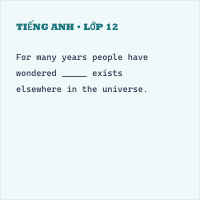
For many years people have wondered _____ exists elsewhere in the universe.

  • A.

    that life

  • B.

    life which

  • C.

    whether life 

  • D.

    life as it

Chưa có lời giải

Câu 2 (0.25đ)

A home for children whose parents are dead is called a(n)_____

  • A.

    kindergarten

  • B.

    orphanage

  • C.

    street people house

  • D.

    lodging

Chưa có lời giải

Câu 3 (0.25đ)

After leaving high school, a student can apply for a position either university_____a vocational school.

  • A.

    with

  • B.

    and

  • C.

    nor

  • D.

    or

Chưa có lời giải

Câu 4 (0.25đ)

Mark the letter A, B, C, or D on your answer sheet to indicate the underlined part that needs correction in each of the following questions.

Despite modern medical technology, many diseases causing by viruses I are still not curable.

  • A.

    Despite

  • B.

    many

  • C.

    causing

  • D.

    curable

Chưa có lời giải

Câu 5 (0.25đ)

Mark the letter A, B, C, or D on your answer sheet to indicate the sentence that is closest in meaning to each of the following questions.

"You had better see a doctor if the sore throat does not clear up," she said to me.

  • A.

    She reminded me of seeing a doctor if the sore throat did not clear up.

  • B.

    She ordered me to see a doctor if the sore throat did not clear up.

  • C.

    She insisted that I see a doctor unless the sore throat did not clear up.

  • D.

    She suggested that I see a doctor if the sore throat did not clear up.

Chưa có lời giải

Câu 6 (0.25đ)

After feeling off_____for days, Tom finally went to see his doctor.

  • A.

    food

  • B.

    color

  • C.

    fitness

  • D.

    balance

Chưa có lời giải

Câu 7 (0.25đ)

Read the following passage and mark the letter A, B, C, or D on your answer sheet to indicate the correct answer to each of the questions from 36 to 42.

People have been donating blood since the early twentieth century to help accident victims and patients undergoing surgical procedures. Usually a pint of whole blood is donated, and it is then divided into platelets, white blood cells, and red blood cells. People can donate blood (for red blood cells] about once every two months. Transfusing the blood from the donor to the recipient is straightforward. It involves taking the blood from a donor's arm vein by means of a hypodermic syringe. The blood flows through a plastic tube to a collection bag or bottle that contains sodium citrate, which prevents the blood from clotting. When the blood is given to a patient, a plastic tube and hypodermic needle are connected to the recipient's arm. The blood flows down from the container by gravity. This is a slow process and may last as long as 2 hours to complete the infusion of blood into the recipient. The patient is protected from being infected during the transfusion. Only sterile containers, tubing, and needles are used, and this helps ensure thattransfused or stored blood is not exposed to disease causing bacteria. Negative reactions to transfusions are not unusual. The recipient may suffer an allergic reaction or be sensitive to donor leukocytes. Some may suffer from an undetected red cell incompatibility. Unexplained reactions are also fairly common, Although they are rare, other causes of such negative reactions include contaminated blood, air bubbles in the blood, overloading of the circulatory system through administration of excess blood, or sensitivity to donor plasma or platelets. Today, hospitals and blood banks go to great lengths to screen all blood donors and their blood. All donated blood is routinely and rigorously tested for diseases, such as HIV, hepatitis B, and syphilis. When the recipient is a newborn or an infant, the blood is usually irradiated to eliminate harmful elements. Donated blood is washed, and the white blood cells and platelets removed. Storing the blood sometimes requires a freezing process. To freeze the red blood cells, a glycerol solution is added. To unfreeze, the glycerolis removed. The ability to store blood for long periods has been a boon to human health.

What does the author imply in the passage?

  • A.

    Donating blood benefits mankind.

  • B.

    Clotting cannot be prevented.

  • C.

    Freezing blood destroys platelets.

  • D.

    Transfusing blood is a dangerous process.

Chưa có lời giải

Câu 8 (0.25đ)

Tom looks so frightened and upset. He_____something terrible.

  • A.

    may have experienced

  • B.

    could have experienced

  • C.

    should have experienced

  • D.

    must have experienced

Chưa có lời giải

Câu 9 (0.25đ)

Read the following passage and mark the letter A, B, C, or D on your answer sheet to indicate the correct word or phrase that best fits each of the numbered blanks from 31 to 35.

Many people enjoy lying in bed in the morning, but can you imagine having to spend 90 days in bed? Could you stand the boredom and the frustration of not being(31)_____ to get up? That was the task that faced 14 volunteers when they started out on a bed-rest experiment being conducted (32)_____ the European Space Agency.

The study had a serious purpose: to investigate the changes that take place in the human body during long-duration spaceflight. Lying in a horizontal position was the best way of (33)_____ weightlessness. The aim was to discover what effect period of weightlessness will
have on the health of astronauts spending several months on the International Space Station.

The volunteers ate their meals, took showers and underwent medical tests without ever sitting up. That's even tougher than it sounds, especially when you (34)_____ that no visitors were permitted. However, each volunteer did have a mobile phone, as well as access to the latest films,

computer games and music. Surprisingly, Everyone was in a good (35)_____ at the end of the
90 days, 'I would do it again,' said one of the volunteers. 'It was disorientating, but we knew we were 'contributing to medical research and space exploration.

Điền vào ô 31.

  • A.

    enabled

  • B.

    allowed

  • C.

    granted

  • D.

    approved

Chưa có lời giải

Câu 10 (0.25đ)

She frequently volunteers_____extra work because she really likes her job.

  • A.

    to

  • B.

    for

  • C.

    with

  • D.

    in

Chưa có lời giải

Câu 11 (0.25đ)

Alan _____ is an official document stating that you have passed an examination,completed a course, or achieved some necessary qualifications.

  • A.

    certificate

  • B.

    requirement

  • C.

    education

  • D.

    test

Chưa có lời giải

Câu 12 (0.25đ)

Read the following passage and mark the letter A, B, C, or D on your answer sheet to indicate the correct word or phrase that best fits each of the numbered blanks from 31 to 35.

Many people enjoy lying in bed in the morning, but can you imagine having to spend 90 days in bed? Could you stand the boredom and the frustration of not being(31)_____ to get up? That was the task that faced 14 volunteers when they started out on a bed-rest experiment being conducted (32)_____ the European Space Agency.

The study had a serious purpose: to investigate the changes that take place in the human body during long-duration spaceflight. Lying in a horizontal position was the best way of (33)_____ weightlessness. The aim was to discover what effect period of weightlessness will
have on the health of astronauts spending several months on the International Space Station.

The volunteers ate their meals, took showers and underwent medical tests without ever sitting up. That's even tougher than it sounds, especially when you (34)_____ that no visitors were permitted. However, each volunteer did have a mobile phone, as well as access to the latest films,

computer games and music. Surprisingly, Everyone was in a good (35)_____ at the end of the
90 days, 'I would do it again,' said one of the volunteers. 'It was disorientating, but we knew we were 'contributing to medical research and space exploration.

Điền vào ô 35.

  • A.

    attitude

  • B.

    spirit

  • C.

    feeling

  • D.

    mood

Chưa có lời giải

Câu 13 (0.25đ)

Read the following passage and mark the letter A, B, C, or D on your answer sheet to indicate the correct answer to each of the questions from 36 to 42.

People have been donating blood since the early twentieth century to help accident victims and patients undergoing surgical procedures. Usually a pint of whole blood is donated, and it is then divided into platelets, white blood cells, and red blood cells. People can donate blood (for red blood cells] about once every two months. Transfusing the blood from the donor to the recipient is straightforward. It involves taking the blood from a donor's arm vein by means of a hypodermic syringe. The blood flows through a plastic tube to a collection bag or bottle that contains sodium citrate, which prevents the blood from clotting. When the blood is given to a patient, a plastic tube and hypodermic needle are connected to the recipient's arm. The blood flows down from the container by gravity. This is a slow process and may last as long as 2 hours to complete the infusion of blood into the recipient. The patient is protected from being infected during the transfusion. Only sterile containers, tubing, and needles are used, and this helps ensure thattransfused or stored blood is not exposed to disease causing bacteria. Negative reactions to transfusions are not unusual. The recipient may suffer an allergic reaction or be sensitive to donor leukocytes. Some may suffer from an undetected red cell incompatibility. Unexplained reactions are also fairly common, Although they are rare, other causes of such negative reactions include contaminated blood, air bubbles in the blood, overloading of the circulatory system through administration of excess blood, or sensitivity to donor plasma or platelets. Today, hospitals and blood banks go to great lengths to screen all blood donors and their blood. All donated blood is routinely and rigorously tested for diseases, such as HIV, hepatitis B, and syphilis. When the recipient is a newborn or an infant, the blood is usually irradiated to eliminate harmful elements. Donated blood is washed, and the white blood cells and platelets removed. Storing the blood sometimes requires a freezing process. To freeze the red blood cells, a glycerol solution is added. To unfreeze, the glycerolis removed. The ability to store blood for long periods has been a boon to human health.

All of the following are mentioned as potential negative reactions to transfusion EXCEPT______.

  • A.

    Sensitivity to donor leukocytes

  • B.

    Air bubbles in the blood

  • C.

    Allergies

  • D.

    Red-cell incompatibility

Chưa có lời giải

Câu 14 (0.25đ)

The local authority asked for a _____ contribution from the community torepair roads and bridges.

  • A.

    volunteer

  • B.

    voluntary 

  • C.

    voluntarily

  • D.

    voluntariness

Chưa có lời giải

Câu 15 (0.25đ)

Mark the letter A, B, C, or D on your answer sheet to indicate the sentence that is closest in meaning to each of the following questions.

Without her teacher's advice, she would never have written such a good essay.

  • A.

    Her teacher advised her and she didn't write a good essay.

  • B.

    Her teacher didn't advise her and she didn't write a good essay.

  • C.

    She wrote a good essay as her teacher gave her some advice.

  • D.

    If her teacher didn't advise her, she wouldn't write such a good essay.

Chưa có lời giải

Câu 16 (0.25đ)

Read the following passage and mark the letter A, B, C, or D on your answer sheet to indicate the correct word or phrase that best fits each of the numbered blanks from 31 to 35.

Many people enjoy lying in bed in the morning, but can you imagine having to spend 90 days in bed? Could you stand the boredom and the frustration of not being(31)_____ to get up? That was the task that faced 14 volunteers when they started out on a bed-rest experiment being conducted (32)_____ the European Space Agency.

The study had a serious purpose: to investigate the changes that take place in the human body during long-duration spaceflight. Lying in a horizontal position was the best way of (33)_____ weightlessness. The aim was to discover what effect period of weightlessness will
have on the health of astronauts spending several months on the International Space Station.

The volunteers ate their meals, took showers and underwent medical tests without ever sitting up. That's even tougher than it sounds, especially when you (34)_____ that no visitors were permitted. However, each volunteer did have a mobile phone, as well as access to the latest films,

computer games and music. Surprisingly, Everyone was in a good (35)_____ at the end of the
90 days, 'I would do it again,' said one of the volunteers. 'It was disorientating, but we knew we were 'contributing to medical research and space exploration.

Điền vào ô 32.

  • A.

    by

  • B.

    on

  • C.

    for

  • D.

    about

Chưa có lời giải

Câu 17 (0.25đ)

Read the following passage and mark the letter A, B, C, or D on your answer sheet to indicate the correct answer to each of the questions from 36 to 42.

People have been donating blood since the early twentieth century to help accident victims and patients undergoing surgical procedures. Usually a pint of whole blood is donated, and it is then divided into platelets, white blood cells, and red blood cells. People can donate blood (for red blood cells] about once every two months. Transfusing the blood from the donor to the recipient is straightforward. It involves taking the blood from a donor's arm vein by means of a hypodermic syringe. The blood flows through a plastic tube to a collection bag or bottle that contains sodium citrate, which prevents the blood from clotting. When the blood is given to a patient, a plastic tube and hypodermic needle are connected to the recipient's arm. The blood flows down from the container by gravity. This is a slow process and may last as long as 2 hours to complete the infusion of blood into the recipient. The patient is protected from being infected during the transfusion. Only sterile containers, tubing, and needles are used, and this helps ensure thattransfused or stored blood is not exposed to disease causing bacteria. Negative reactions to transfusions are not unusual. The recipient may suffer an allergic reaction or be sensitive to donor leukocytes. Some may suffer from an undetected red cell incompatibility. Unexplained reactions are also fairly common, Although they are rare, other causes of such negative reactions include contaminated blood, air bubbles in the blood, overloading of the circulatory system through administration of excess blood, or sensitivity to donor plasma or platelets. Today, hospitals and blood banks go to great lengths to screen all blood donors and their blood. All donated blood is routinely and rigorously tested for diseases, such as HIV, hepatitis B, and syphilis. When the recipient is a newborn or an infant, the blood is usually irradiated to eliminate harmful elements. Donated blood is washed, and the white blood cells and platelets removed. Storing the blood sometimes requires a freezing process. To freeze the red blood cells, a glycerol solution is added. To unfreeze, the glycerolis removed. The ability to store blood for long periods has been a boon to human health.

Based on the information in the passage, what can be inferred about blood transfused to infants and newborns?


  • A.

    It is treated with radiant energy.

  • B.

    It is not treated differently from adults.

  • C.

    It is not dangerous for children.

  • D.

    It is rigorously tested as blood for adults.

Chưa có lời giải

Câu 18 (0.25đ)

Some high school students often_____helping the disadvantaged or handicappedchildren.

  • A.

    look after

  • B.

    clean up

  • C.

    make out

  • D.

    participate in

Chưa có lời giải

Câu 19 (0.25đ)

Mark the letter A, B, C, or D on your answer sheet to indicate the word(s) CLOSEST in meaning to the underlined word(s) in each of the following questions.

In England, primary education is provided by state schools run by the government and by independent fee-paying schools.

  • A.

    public

  • B.

    obligatory

  • C.

    vocational

  • D.

    category

Chưa có lời giải

Câu 20 (0.25đ)

Mark the letter A, B, C, or D on your answer sheet to indicate the word(s) OPPOSITE in meaning to the underlined word(s) in each of the following questions.

My brother is an old hand at fixing household appliances. I'm sure he can help you.

  • A.

    a green hand

  • B.

    a blue hand

  • C.

    a new hand

  • D.

    a red hand

Chưa có lời giải

Xem tiếp khoảng 50% câu hỏi còn lại

Để xem tiếp các câu hỏi còn lại, đáp án hoặc lời giải, vui lòng nhấn nút dưới đây.