


DayThemIconLogo
DayThemTextLogoDayThemSpecificTextLogo

Đề thi giữa kì 1 Tiếng Anh 11 có đáp án- Đề 4
Đề thi giữa kì 1 Tiếng Anh 11 có đáp án- Đề 4

Trắc nghiệm tiếng anh lớp 11

Tổng câu hỏi: 31
Thời gian làm: 00:57:00

Tổng câu hỏi: 31

Thời gian làm: 00:57:00

T

Để làm bài, vui lòng nhấn Bắt đầu làm

➔

Học tại nhà hoặc online với gia sư / giáo viên ngay

Nguyễn Tuyết Xuân
Nguyễn Võ Đăng Trình
Nguyễn Bảo Ngọc
Nguyễn Phương Mai
Nguyễn Thị Như Mai
Câu 1 (0.32đ)

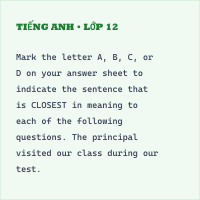
Mark the letter A, B, C, or D on your answer sheet to indicate the sentence that is CLOSEST in meaning to each of the following questions.

The principal visited our class during our test.

  • A.

    The principal dropped into our class when we had done our test.

  • B.

    As we were having a test, the principal was visiting our class.

  • C.

    When the principal dropped by, we were doing a test.

  • D.
    While we were having a test, the principal dropped into.

Chưa có lời giải

Câu 2 (0.32đ)

Read the following passage and mark the letter A, B, C, or D on your answer sheet to indicate the correct answer to each of the questions from 39 to 43.

On 28 December 2012, Jiroemon Kimura became the verified oldest man in history. When he died in 2013, he was considered the only man that had lived to the age of 116. Born in the fishing village of Kamiukawa, Jiroemon Kimura was the fifth child of an eight-child family of farmers Morizo and Fusa Miyake. Like Jiroemon Kimura, four of his siblings lived into their nineties. In his childhood, Jiroemon Kimura was described as an intelligent primary school boy. After 8 years at school, he started work on the family farm in 1911 and became a telegraph boy at the same time. He served the army for some years before getting back to his work in post offices. By the time he retired, he had worked for post offices for 45 years. In his later life, Kimura lived with his eldest son’s family and helped his son run the family farm. Subsequently, Kimura lived with his eldest grandson’s family for the rest of his life.

What is the main idea of the passage?

  • A.
    A biography of a supercentenarian  
  • B.
    A guide on how to be a supercentenarian
  • C.
    A description of a supercentenarian 
  • D.
    A novel about a supercentenarian

Chưa có lời giải

Câu 3 (0.32đ)

Mark the letter A, B, C, or D on your answer sheet to indicate the word(s) OPPOSITE in meaning to the underlined word(s) in each of the following questions.

I’m sure it was hard work to select pieces of 488-hour raw footage to make a 90-minute documentary titled Home (2009).

  • A.
    cooked
  • B.
    unprocessed
  • C.
    real
  • D.
    finished

Chưa có lời giải

Câu 4 (0.32đ)

My family has lived in this village for many _______.

  • A.
    categories          
  • B.
    descendants       
  • C.
    generations          
  • D.
    ancestors

Chưa có lời giải

Câu 5 (0.32đ)

Mark the letter A, B, C, or D on your answer sheet to indicate the word whose underlined part differs from the other three in pronunciation in each of the following sentences.

  • A.
    educated
  • B.
    beloved
  • C.
    persuaded
  • D.
    transformed

Chưa có lời giải

Câu 6 (0.32đ)

Mark the letter A, B, C, or D on your answer sheet to indicate the sentence that is CLOSEST in meaning to each of the following questions.

During his time in London, Jack used to go jogging every morning.

  • A.
    Jack has got used to jogging every morning since he studied abroad in London.
  • B.
    Jack was in the habit of jogging every morning when studying abroad in London.
  • C.
    Jack had gone jogging every morning by the time he studied abroad in London.
  • D.
    As Jack was studying abroad in London, he was jogging every morning.

Chưa có lời giải

Câu 7 (0.32đ)

Mark the letter A, B, C, or D on your answer sheet to indicate the word(s) OPPOSITE in meaning to the underlined word(s) in each of the following questions.

I was surprised at the profound changes my hometown had undergone over the two decades.

  • A.
    negligible
  • B.
    considerable
  • C.
    noticeable
  • D.
    unavoidable

Chưa có lời giải

Câu 8 (0.32đ)

The dinner was a real _______. I wished we had gone to another restaurant.

  • A.
    let-down            
  • B.
    break-down       
  • C.
    take-away          
  • D.
    put-away

Chưa có lời giải

Câu 9 (0.32đ)

This camera helps you _______ a perfect image of the landscape you’re enjoying.

  • A.
    arrest                 
  • B.
    captivate            
  • C.
    capture              
  • D.
    catch

Chưa có lời giải

Câu 10 (0.32đ)

Mark the letter A, B, C, or D on your answer sheet to indicate the word(s) CLOSEST in meaning to the underlined word(s) in each of the following questions.

Unless you keep your parents informed, they are likely to be more and more distrustful.

  • A.
    doubtful
  • B.
    trustworthy
  • C.
    strict
  • D.
    lenient

Chưa có lời giải

Câu 11 (0.32đ)

Read the following passage and mark the letter A, B, C, or D on your answer sheet to indicate the correct word or phrase that best fits each of the numbered blanks from 34 to 38.

The noun “memorabilia” describes items that remind you (34)_______ a certain event or time. It is derived from the Latin word “memorare”, (35)_______ “to bring to mind”. Memorabilia are saved to help their owner (36)_______ his or her memory. Some parents keep every drawing and report card their children bring (37)_______. They are actually collecting memorabilia for the future. As an item of memorabilia, a t-shirt, which is designed to commemorate an event, is (38)_______ of “been there, done that”.

The noun “memorabilia” describes items that remind you (34)_______ a certain event or time.
  • A.

    about                 

  • B.
    to                       
  • C.
    of                       
  • D.
    in

Chưa có lời giải

Câu 12 (0.32đ)

She’s frustrated that she has to do all the household chores _______ his sister doesn’t.

  • A.
    when                 
  • B.
    that                    
  • C.
    while                 
  • D.
    which

Chưa có lời giải

Câu 13 (0.32đ)

Mark the letter A, B, C, or D on your answer sheet to indicate the word(s) CLOSEST in meaning to the underlined word(s) in each of the following questions.

We are a non-profit organisation, so all the proceeds will go into our charity fund for disadvantaged children in remote areas.

  • A.
    loss
  • B.
    gains
  • C.
    debts
  • D.
    deposit

Chưa có lời giải

Câu 14 (0.32đ)

The two friends decided on a project but they never got _______ with it.

  • A.
    through             
  • B.
    off                      
  • C.
    over                   
  • D.
    away

Chưa có lời giải

Câu 15 (0.32đ)

Read the following passage and mark the letter A, B, C, or D on your answer sheet to indicate the correct answer to each of the questions from 44 to 50.

Geocaching holds an appeal to teachers and students. It offers a wide variety of physical, social and educational benefits. It goes without saying that geocaching makes its participants physically active. Geocaches are used as a form of point-to-point racing. What distinguishes geocaching from other races is its self-pace. It caters individual needs of physical activity and fitness. Participants can start slowly for geocaches within short distances before moving to next levels with cache sites over longer distances. Varying the environment in which caches are hunted is an excellent way to build and maintain motivation. The sense of achievement and adventure in finding a geocache also brings psychological benefits. Keeping fit by geocaching is of endless interest thanks to its variations in locations, distances and intensity. Additionally, geocaching offers the camaraderie that comes with belonging and being part of a group with common interests. There are now online communities of geocachers who are more than willing to discuss and exchange their geocaching stories. Such communities also organise local events to socialise and talk about their interests. Well designed, geocaching encourages group problem solving and fosters improved group communication. In terms of education, the benefits of geocaching simply know no bounds. It offers an ideal tool to enrich students’ knowledge, arouse their interest and curiosity and combine learning with physical exercise. A well-planned geocaching activity in a historical site exploits students’ foreknowledge and urges them to explore new information. Above all, it naturally integrates soft skills into an academic lesson. All in all, geocaching is an excellent tool for educators and students.

What is the main idea of the passage?

  • A.
    The history of geocaching               
  • B.
    The participants of geocaching
  • C.
    The benefits of geocaching              
  • D.
    The disadvantages of geocaching

Chưa có lời giải

Xem tiếp khoảng 50% câu hỏi còn lại

Để xem tiếp các câu hỏi còn lại, đáp án hoặc lời giải, vui lòng nhấn nút dưới đây.