DayThemIconLogo
DayThemTextLogoDayThemSpecificTextLogo

Bộ đề luyện thi Chuyên Anh năm 2023 có đáp án (Đề 89)

Bộ đề luyện thi Chuyên Anh năm 2023 có đáp án (Đề 89)

Trắc nghiệm tiếng anh lớp 9

Tổng câu hỏi: 49
Thời gian làm: 01:29:00

Tổng câu hỏi: 49

Thời gian làm: 01:29:00

D

Để làm bài, vui lòng nhấn Bắt đầu làm

➔

Học tại nhà hoặc online với gia sư / giáo viên ngay

Huỳnh Võ Anh Kiệt
Nguyễn Phương Thảo Ly
Nguyễn Trọng Minh
Nguyễn Phạm Cao Quân
Huỳnh Minh Trí
Câu 1 (0.2đ)
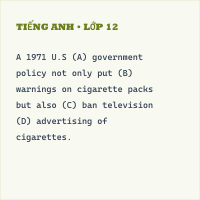
A 1971 U.S (A) government policy not only put (B) warnings on cigarette packs but also (C) ban television (D) advertising of cigarettes.
  • A.
    government
  • B.
    warnings
  • C.
    ban
  • D.
    advertising

Chưa có lời giải

Câu 2 (0.2đ)

Read the following passage and choose the answer to each of the questions from 61 to 70.

Esperanto is what is called a planned, or artificial, language. It was created more than a century ago by Polish eye doctor Ludwik Lazar Zamenhof. Zamenhof believed that a common language would help to alleviate some of the misunderstandings among cultures. In Zamenhof’s first attempt at a universal language, he tried to create a language that was as uncomplicated as possible. This first language included words such as ab, ac, ba, eb, be, and ce. This did not result in a workable language in that these monosyllabic words, though short, were not easy to understand or to retain. Next, Zamenhof tried a different way of constructing a simplified language. He made the words in his language sound like words that people already knew, but he simplified the grammar tremendously. One example of how he simplified the language can be seen in the suffixes: all nouns in this language end in o, as in the noun amiko, which means “friend”, and all adjectives end in -a, as in the adjective bela, which means “pretty”. Another example of the simplified language can be seen in the prefix mal-, which makes a word opposite in meaning; the word malamiko therefore means “enemy”, and the word malbela therefore means “ugly” in Zamenhof’s language. In 1887, Zamenhof wrote a description of this language and published it. He used a pen name, Dr. Esperanto, when signing the book. He selected the name Esperanto because this word means “a person who hopes” in his language. Esperanto clubs began popping up throughout Europe, and by 1950, Esperanto had spread from Europe to America and Asia. In 1905, the First World Congress of Esperanto took place in France, with approximately700 attendees from 20 different countries. Congresses were held annually for nine years, and 4,000 attendees were registered for the Tenth World Esperanto Congress scheduled for 1914, when World War I erupted and forced its cancellation. Esperanto has had its ups and downs in the period since World War I. Today, years after it was introduced, it is estimated that perhaps a quarter of a million people are fluent in it. This may seem like a large number, but it is really quite small when compared with the billion English speakers and billion Mandarin Chinese speakers in today’s world. Current advocates would like to see its use grow considerably and are taking steps to try to make this happen.


Economic resources can be broken down into (32) _________ general categories: property resource – land and capital, and human resources – labor and entrepreneurial skills.
  • A.
    some
  • B.
    many
  • C.
    two
  • D.
    six

Chưa có lời giải

Câu 3 (0.2đ)

Read the following passage and choose the answer to each of the questions  

      Quite different from storm surges are the giant sea waves called tsunamis, which derive their name from the Japanese expression for “high water in a harbor.” These waves are also referred to by the general public as tidal waves, although they have relatively little to do with tides. Scientists often referred to them as seismic sea waves, far more appropriate in that they do result from undersea seismic activity.        Tsunamis are caused when the sea bottom suddenly moves, during an underwater earthquake or volcano for example, and the water above the moving earth is suddenly displaced. This sudden shift of water sets off a series of waves. These waves can travel great distances at speeds close to 700 kilometers per hour. In the open ocean, tsunamis have little noticeable amplitude, often no more than one or two meters. It is when they hit the shallow waters near the coast that they increase in height, possibly up to 40 meters.        Tsunamis often occur in the Pacific because the Pacific is an area of heavy seismic activity. Two areas of the Pacific well accustomed to the threat of tsunamis are Japan and Hawaii. Because the seismic activity that causes tsunamis in Japan often occurs on the ocean bottom quite close to the islands, the tsunamis that hit Japan often come with little warning and can, therefore, prove disastrous. Most of the tsunamis that hit the Hawaiian Islands, however, originate thousands of miles away near the coast of Alaska, so these tsunamis have a much greater distance to travel and the inhabitants of Hawaii generally have time for warning of their imminent arrival.        Tsunamis are certainly not limited to Japan and Hawaii. In 1755, Europe experienced a calamitous tsunami, when movement along the fault lines near the Azores caused a massive tsunami to sweep onto the Portuguese coast and flood the heavily populated area around Lisbon. The greatest tsunami on record occurred on the other side of the world in 1883 when the Krakatoa volcano underwent a massive explosion, sending waves more than 30 meters high onto nearby Indonesian islands; the tsunami from this volcano actually traveled around the world and was witnessed as far away as the English Channel. 

The paragraph preceding this passage most probably discusses

  • A.
    tides
  • B.
    storm surges
  • C.
    tidal waves
  • D.
    underwater earthquakes

Chưa có lời giải

Câu 4 (0.2đ)
Snapping turtles are (A) easily recognized (B) because of the large head, the long tail and the shell that seems (C) unsufficiently(D) to protect the body.
  • A.
    easily
  • B.
    because of
  • C.
    unsufficiently
  • D.
    to protect

Chưa có lời giải

Câu 5 (0.2đ)
Some scientists think that a meteor impact, which occurred around 65 million years ago, may have caused the extinction of the dinasaurs.
  • A.
    Some scientists reckon that the impact of a meteor that struck Earth some 65 million years ago need not have caused the extinction of the dinosaurs.
  • B.
    In the opinion of some scientists, the extinction of the dinosaurs could have been the result of the impact of a meteor which occurred roughly 65 million years ago.
  • C.
    According to some scientists, the extinction of the dinosaurs was caused by a meteor that struck Earth 65 million or so years ago.
  • D.
    The extinction of the dinosaurs could only have been caused by a meteor impact that occurred some 65 million years ago.

Chưa có lời giải

Câu 6 (0.2đ)

Choose the sentence that is correct and closest in meaning to each of the following sentences

There are two interesting things I found in The Last Leaf by O. Henry in addition to the general theme of death and dying.

  • A.
    The general theme of death and dying is the most interesting thing I found in The Last Leaf by O. Henry.
  • B.
    In The Last Leaf by O. Henry two interesting things about death and dying are additional themes I found.
  • C.
    The general theme of death and dying is what I found interesting in The Last Leaf by O. Henry besides the other two things.
  • D.
    The general theme of death and dying is one interesting thing I found in The Last Leaf by O. Henry.

Chưa có lời giải

Câu 7 (0.2đ)
Many have said that if he had not needed the money as a writer, he would have had the freedom to explore his potential.
  • A.
    It has been said that without his need for money as a writer, he would have explored the freedom of his potential.
  • B.
    Many have said that it was the need for money that made him explore his potential.
  • C.
    Many have said that he needed money as a writer more than his freedom to explore his potential.
  • D.
    It has been said that because he needed the money as a writer, he didn’t have the freedom to explore his potential.

Chưa có lời giải

Câu 8 (0.2đ)

Read the following passage and choose the word or phrase that best fits each of the numbered blanks

What is meant by the term economic resources? In general, these are all the natural, man-made, and human resources that go into the (31) ________ of goods and services. Economic resources can be broken down into (32) ________ general categories: property resource – land and capital, and human resources – labor and entrepreneurial skills. What do economists mean (33) ________ land? Much more than the non-economist, land refers to all the natural resources (34) ________ are usable in the production process: arable land, forests, mineral and oil deposits, and (35) ________ on. What about capital? Capital goods are all the man-made aids to producing, storing, transporting, and distributing goods and (36) ________. Capital goods differ from consumer goods in that (37) ________ satisfy wants directly, while the former do so indirectly by facilitating the production of consumer goods. It should be noted that capital as defined here does not (38) ________ to money. Money, as such, produces nothing. The term labor refers to the physical and mental talents of humans used to produce goods and services (with the exception of a certain set of human talents, entrepreneurial skills, which will be considered separately because of their special significance). Thus the services of a factory worker or an office worker, a ballet (39) ________ or an astronaut all fall (40) ________ the general heading of labor.

In general, these are all the natural, man-made, and human resources that go into the (31) ________ of goods and services.

  • A.
    doing
  • B.
    plant
  • C.
    using
  • D.
    production

Chưa có lời giải

Câu 9 (0.2đ)

Choose the word or phrase closest in meaning to the underlined word(s)

I used to meet him occasionally on Fifth Avenue.

  • A.
    in one occasion
  • B.
    once in a while
  • C.
    one time
  • D.
    none is correct

Chưa có lời giải

Câu 10 (0.2đ)

Choose the underlined part that needs correction in each of the following questions

Some of the agricultural (A) practices(B) used today (C) is responsible for (D) fostering desertification.

  • A.
    Practices
  • B.
    Used
  • C.
    Is
  • D.
    fostering

Chưa có lời giải

Câu 11 (0.2đ)
“Excuse me. I’m your new neighbor. I just moved in.”“__________.”
  • A.
    Where to, sir?
  • B.
    Sorry, I don’t know
  • C.
    Oh, I don’t think so
  • D.
    I’m afraid not

Chưa có lời giải

Câu 12 (0.2đ)
By the year 2050, many people currently employed __________ their jobs.
  • A.
    have lost
  • B.
    will be losing
  • C.
    will have lost
  • D.
    are losing

Chưa có lời giải

Câu 13 (0.2đ)
Students can __________ a lot of information just by attending class and taking good notes of the lectures.
  • A.
    provide
  • B.
    transmit
  • C.
    read
  • D.
    absorb

Chưa có lời giải

Câu 14 (0.2đ)
In 1975, the successful space probe to __________ beginning to send information back to earth.
  • A.
    Venus it was
  • B.
    Venus
  • C.
    Venus was
  • D.
    Venus the

Chưa có lời giải

Câu 15 (0.2đ)
Biogas can be utilized for electricity production, cooking, space heating, water heating and process heating.
  • A.
    increase
  • B.
    sparing
  • C.
    generation
  • D.
    reformation

Chưa có lời giải

Câu 16 (0.2đ)
Space travel seemed __________ but it has come true now.
  • A.
    unthinkable
  • B.
    unable
  • C.
    disbelievable
  • D.
    disagreeable

Chưa có lời giải

Câu 17 (0.2đ)
For more than a decade, ___________ that certain species are becoming scarce.
  • A.
    a warning for bird-watchers
  • B.
    warn the bird-watcher
  • C.
    the warnings of bird-watchers
  • D.
    bird-watchers have warned

Chưa có lời giải

Câu 18 (0.2đ)
She decided to remain celibate and devote her life to helping the homeless and orphans.
  • A.
    divorced
  • B.
    married
  • C.
    single
  • D.
    separated

Chưa có lời giải

Câu 19 (0.2đ)
He left the country __________ arrest if he returned.
  • A.
    with fear of
  • B.
    under threat of
  • C.
    with threat of
  • D.
    in fear of

Chưa có lời giải

Câu 20 (0.2đ)
We spent the entire day looking for a new apartment.
  • A.
    the long day
  • B.
    all long day
  • C.
    day after day
  • D.
    all day long

Chưa có lời giải

Câu 21 (0.2đ)
Choose the word that differs from the rest in the position of the main stress in each of the following questions
  • A.
    elaborately
  • B.
    flamingo
  • C.
    embryo
  • D.
    gazelle

Chưa có lời giải

Câu 22 (0.2đ)
The city has __________ of young consumers who are sensitive to trends, and can, therefore, help industries predict the potential risks and success of products.
  • A.
    a high tendency
  • B.
    a high rate
  • C.
    a high proportion
  • D.
    a great level

Chưa có lời giải

Câu 23 (0.2đ)

Choose the correct answer to each of the following questions.

___________ giraffe is the tallest of all __________animals.

  • A.
    A/ ø
  • B.
    ø/ the
  • C.
    The/ ø
  • D.
    A/ the

Chưa có lời giải

Câu 24 (0.2đ)
____ at the Isthmus of Panama, so animals were able to migrate between North and South America.
  • A.
    With a land bridge
  • B.
    A land bridge
  • C.
    A land bridge existed
  • D.
    When a land bridge existed

Chưa có lời giải

Xem tiếp khoảng 50% câu hỏi còn lại

Để xem tiếp các câu hỏi còn lại, đáp án hoặc lời giải, vui lòng nhấn nút dưới đây.