DayThemIconLogo
DayThemTextLogoDayThemSpecificTextLogo
ab testing

Reading

Trắc nghiệm tiếng anh lớp 10

Tổng câu hỏi:9
Thời gian làm: 00:25:00

Tổng câu hỏi: 9

Thời gian làm: 00:25:00

H
Câu 1 (1.11đ)

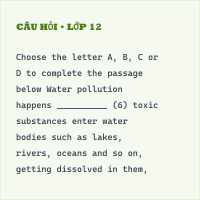
Choose the letter A, B, C or D to complete the passage below

  Water pollution happens __________ (6) toxic substances enter water bodies such as lakes, rivers, oceans and so on, getting dissolved in them, lying suspended in the water or depositing on the bed. This degrades the quality of water. Not __________ (7) does this spell disaster for aquatic ecosystems, the pollutants also seep through and reach the groundwater, which might end up in our households as contaminated water we use in our daily activities, including drinking.

  Water pollution can be __________ (8) in a number of ways, one of the most polluting being city sewage and industrial waste discharge. Indirect sources __________ (9) water pollution include contaminants that enter the water supply from soils or groundwater systems and from the atmosphere via rain. Soils and groundwater contain __________ (10) residue of human agricultural practices and also improperly disposed of industrial wastes.

  Pollutants can be of varying kinds: organic, inorganic, radioactive and so on. In fact, the list of possible water contaminants is just too vast to be listed here.

Điền vào ô số 6

  • A.

    what     

  • B.

    when     

  • C.

    why    

  • D.

    while 

Chưa có lời giải

Đã ẩn 50% câu hỏi phần đầu

Để xem các câu đã ẩn, lời giải hoặc đáp án, vui lòng bấm nút dưới đây.

Câu 5 (1.11đ)

Choose the letter A, B, C or D to complete the passage below

  National parks are large areas of public land set aside for native plants, animals and the places in which they live. National parks protect places of natural beauty. National park is home to many endemic species. They also protect places important to Aboriginal people, and places that show how people lived in the past.

  National parks are actually protected areas. IUCN definition of a protected area: “A clearly defined geographical space, recognized, dedicated and managed, through legal or other effective means, to achieve the long-term conservation of nature with associated ecosystem services and cultural values”.

  Conservation of biodiversity (the variety of our native species and the ecosystems they form) is the central purpose of protected areas. High levels of biodiversity keep ecosystems healthy and resilient, which means that they continue providing vital ecosystem services such as nutrient cycling, climate regulation, air and water purification and pollination.

  Protecting biodiversity is vital to safeguard our economy; our cultural, spiritual and aesthetic values; and the intrinsic value of species and ecosystems. National parks provide a safe home for native plants and animals. They help keep the air and water clean. National parks give us places to enjoy.

What is the main idea of the passage?

  • A.

    the conservation of plants

  • B.

    the features of national parks

  • C.

    the definition and function of national parks

  • D.

    the level of biodiversity 

Chưa có lời giải

Câu 6 (1.11đ)

Choose the letter A, B, C or D to complete the passage below

  National parks are large areas of public land set aside for native plants, animals and the places in which they live. National parks protect places of natural beauty. National park is home to many endemic species. They also protect places important to Aboriginal people, and places that show how people lived in the past.

  National parks are actually protected areas. IUCN definition of a protected area: “A clearly defined geographical space, recognized, dedicated and managed, through legal or other effective means, to achieve the long-term conservation of nature with associated ecosystem services and cultural values”.

  Conservation of biodiversity (the variety of our native species and the ecosystems they form) is the central purpose of protected areas. High levels of biodiversity keep ecosystems healthy and resilient, which means that they continue providing vital ecosystem services such as nutrient cycling, climate regulation, air and water purification and pollination.

  Protecting biodiversity is vital to safeguard our economy; our cultural, spiritual and aesthetic values; and the intrinsic value of species and ecosystems. National parks provide a safe home for native plants and animals. They help keep the air and water clean. National parks give us places to enjoy.

What is the role of high levels of biodiversity?

  • A.

    contaminating the air 

  • B.

    opening a new way 

  • C.

    keeping ecosystems healthy 

  • D.

    Making the environment ditier 

Chưa có lời giải

Câu 7 (1.11đ)

Choose the letter A, B, C or D to complete the passage below

  National parks are large areas of public land set aside for native plants, animals and the places in which they live. National parks protect places of natural beauty. National park is home to many endemic species. They also protect places important to Aboriginal people, and places that show how people lived in the past.

  National parks are actually protected areas. IUCN definition of a protected area: “A clearly defined geographical space, recognized, dedicated and managed, through legal or other effective means, to achieve the long-term conservation of nature with associated ecosystem services and cultural values”.

  Conservation of biodiversity (the variety of our native species and the ecosystems they form) is the central purpose of protected areas. High levels of biodiversity keep ecosystems healthy and resilient, which means that they continue providing vital ecosystem services such as nutrient cycling, climate regulation, air and water purification and pollination.

  Protecting biodiversity is vital to safeguard our economy; our cultural, spiritual and aesthetic values; and the intrinsic value of species and ecosystems. National parks provide a safe home for native plants and animals. They help keep the air and water clean. National parks give us places to enjoy.

National parks provide a safe home for __________ plants and animals.

  • A.

    exotic 

  • B.

    normal 

  • C.

    native 

  • D.

    other

Chưa có lời giải

Câu 8 (1.11đ)

Choose the letter A, B, C or D to complete the passage below

  Water pollution happens __________ (6) toxic substances enter water bodies such as lakes, rivers, oceans and so on, getting dissolved in them, lying suspended in the water or depositing on the bed. This degrades the quality of water. Not __________ (7) does this spell disaster for aquatic ecosystems, the pollutants also seep through and reach the groundwater, which might end up in our households as contaminated water we use in our daily activities, including drinking.

  Water pollution can be __________ (8) in a number of ways, one of the most polluting being city sewage and industrial waste discharge. Indirect sources __________ (9) water pollution include contaminants that enter the water supply from soils or groundwater systems and from the atmosphere via rain. Soils and groundwater contain __________ (10) residue of human agricultural practices and also improperly disposed of industrial wastes.

  Pollutants can be of varying kinds: organic, inorganic, radioactive and so on. In fact, the list of possible water contaminants is just too vast to be listed here.

Điền vào ô số 8

  • A.

    cause

  • B.

    caused

  • C.

    causing

  • D.

    causes 

Chưa có lời giải

Câu 9 (1.12đ)

Choose the letter A, B, C or D to complete the passage below

  National parks are large areas of public land set aside for native plants, animals and the places in which they live. National parks protect places of natural beauty. National park is home to many endemic species. They also protect places important to Aboriginal people, and places that show how people lived in the past.

  National parks are actually protected areas. IUCN definition of a protected area: “A clearly defined geographical space, recognized, dedicated and managed, through legal or other effective means, to achieve the long-term conservation of nature with associated ecosystem services and cultural values”.

  Conservation of biodiversity (the variety of our native species and the ecosystems they form) is the central purpose of protected areas. High levels of biodiversity keep ecosystems healthy and resilient, which means that they continue providing vital ecosystem services such as nutrient cycling, climate regulation, air and water purification and pollination.

  Protecting biodiversity is vital to safeguard our economy; our cultural, spiritual and aesthetic values; and the intrinsic value of species and ecosystems. National parks provide a safe home for native plants and animals. They help keep the air and water clean. National parks give us places to enjoy.

Which one is NOT TRUE about a national park?

  • A.

    large areas of public land 

  • B.

    places of natural beauty 

  • C.

    home to many endemic species 

  • D.

    abandoned area of Aborigines people

Chưa có lời giải