

DayThemIconLogo
DayThemTextLogoDayThemSpecificTextLogo
ab testing

Bộ đề luyện thi Chuyên Anh năm 2023 có đáp án (Đề 83)

Trắc nghiệm tiếng anh lớp 9

Tổng câu hỏi:80
Thời gian làm: 01:30:00

Tổng câu hỏi: 80

Thời gian làm: 01:30:00

K
Câu 1 (0.12đ)

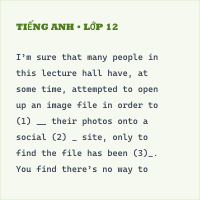
 I’m sure that many people in this lecture hall have, at some time, attempted to open up an image file in order to (1) __ their photos onto a social (2) _ site, only to find the file has been (3)_. You find there’s no way to retrieve your digital memories as you’ve already (4) __ the photos from your memory card. Worse is the realization that your entire hard drive has crashed and that you never made back-up copies of your dissertation, years of research, and so on. Right now, I’m afraid, there’s no guarantee that any of our data will survive in the (5) ___ currently available. You see, manufacturers want to (6) __ the speed and capacity of drivers, but aren’t worried about long-term stability. Flash memory drives are not a reliable alternative as they have an estimated (7) __ lifespan of ten years. Top-end CDs with the gold and the phthalocyanine dye layers will (8) __ longer. The other issue of course, is that technology is constantly becoming obsolete. Many of your parents will have video cassettes at home but unless you have a video player still in (9) __, you are unlikely to ever view the content. The same goes for any documents saved on floppy disks; no modem PC comes with a compatible drive. It’s ironic, of course, that paper, the old (10)__of transferring information, is actually more durable than its modem equivalents.

I’m sure that many people in this lecture hall have, at some time, attempted to open up an image file in order to (1) __ their photos 
  • A.
    paste
  • B.
    display
  • C.
    share
  • D.
    upload

Chưa có lời giải

Đã ẩn 50% câu hỏi phần đầu

Để xem các câu đã ẩn, lời giải hoặc đáp án, vui lòng bấm nút dưới đây.

Câu 40 (0.12đ)
It is estimated that at least a million meteors have hit the Earth’s surface, which is only 25 percentage of the planet.
  • A.
    at least
  • B.
    million
  • C.
    have hit
  • D.
    Percentage

Chưa có lời giải

Câu 41 (0.12đ)
Although fewer Americans work on farms today, they are too productive that the U.S is now the world’s top food exporter.
  • A.
    Although
  • B.
    fewer
  • C.
    too
  • D.
    Top

Chưa có lời giải

Câu 42 (0.12đ)
........in 1776 that the Declaration of Independence was signed.
  • A.
    It was
  • B.
    There was
  • C.
    There
  • D.
    It

Chưa có lời giải

Câu 43 (0.12đ)
They left early because they did not want to get caught in traffic.
  • A.
    They left early for not getting stuck.
  • B.
    In order to avoid being stuck in the traffic, they left early.
  • C.
    Because they got caught in the traffic, they left early.
  • D.

    Leaving late, they got caught in the traffic.

Chưa có lời giải

Câu 44 (0.12đ)
In 1736, the number of poor people in Boston receiving public assistanceabout 4,000.
  • A.
    was
  • B.
    were
  • C.
    it was
  • D.
    they were

Chưa có lời giải

Câu 45 (0.12đ)
Many fruits contain large amounts of vitamin C, as well as sugar, which provide energy.
  • A.
    Many
  • B.
    amounts
  • C.
    as well as
  • D.
    provide

Chưa có lời giải

Câu 46 (0.12đ)
A: Thanks a lot for your help.B: …………………….
  • A.
    Your welcome
  • B.
    You’re welcome
  • C.
    You’re welcomed
  • D.
    You welcomed

Chưa có lời giải

Câu 47 (0.12đ)
Because/ snowstorm/ only/five/ student/ come/ class/ teacher/ therefore/ cancel/ class/.
  • A.
    Because of the snowstorm only five students came to class. The teacher, therefore, cancelled the class.
  • B.
    Because of a snowstorm only five students have come to the class, teacher therefore has cancelled class.
  • C.
    Because the snowstorm only five students came to class the teacher, therefore, had to cancel the class.
  • D.
    Because a snowstorm only five students came to the class; teacher, therefore, cancelled class.

Chưa có lời giải

Câu 48 (0.12đ)

Line Most forms of property are concrete and tangible, such as houses, cars, furniture, or anything else that is included in one’s possessions. Other forms of property can be intangible, and copyright deals with intangible forms of property. Copyright is a legal protection extended to authors of creative works, for example, books, magazine articles, maps, films, plays, television shows, software, paintings, photographs, music, choreography in dance, and all other forms of intellectual or artistic property. Although the purpose of artistic property is usually public use and enjoyment, copyright establishes the ownership of the creator. When a person buys a copyrighted magazine, it belongs to this individual as a tangible object. However, the authors of the magazine articles own the research and the writing that went into creating the articles. The right to make and sell or give away copies of books or articles belongs to the authors, publishers, or other individuals or organizations that hold the copyright. To copy an entire book or a part of it, permission must be received from the copyright owner, who will most likely expect to be paid. Copyright law distinguishes between different types of intellectual property. Music may be played by anyone after it is published. However, if it is performed for profit, the performers need to pay a fee, called a royalty. A similar principle applies to performances of songs and plays. On the other hand, names, ideas, and book titles are excepted. Ideas do not become copyrighted property until they are published in a book, a painting, or a musical work. Almost all artistic work created before the 20th century is not copyrighted because it was created before the copyright law was passed. The two common ways of infringing upon the copyright are plagiarism and piracy. Plagiarizing the work of another person means passing it off as one's own. The word plagiarism is derived from the Latin plagiarus, which means “abductor." Piracy may be an a a of one person but, in many cases, it is a joint effort of several people who reproduce copyrighted material and sell it for profit without paying royalties to the creator. Technological innovations have made piracy easy, and anyone can duplicate a motion picture on videotape, a computer program, or a book. Video cassette recorders can be used by practically anyone to copy movies and television programs, and copying software has become almost as easy as copying a book. Large companies zealously monitor their copyrights for slogans, advertisements, and brand names, protected by a trademark. 

In line 3, the word “extended” is closest in meaning to

  • A.
    explicated
  • B.
    exposed
  • C.
    guaranteed
  • D.
    Granted

Chưa có lời giải

Câu 49 (0.12đ)
Pronunciation
  • A.
    watched
  • B.
    laughed
  • C.
    stuffed
  • D.
    Wicked

Chưa có lời giải

Câu 50 (0.12đ)

 I’m sure that many people in this lecture hall have, at some time, attempted to open up an image file in order to (1) __ their photos onto a social (2) _ site, only to find the file has been (3)_. You find there’s no way to retrieve your digital memories as you’ve already (4) __ the photos from your memory card. Worse is the realization that your entire hard drive has crashed and that you never made back-up copies of your dissertation, years of research, and so on. Right now, I’m afraid, there’s no guarantee that any of our data will survive in the (5) ___ currently available. You see, manufacturers want to (6) __ the speed and capacity of drivers, but aren’t worried about long-term stability. Flash memory drives are not a reliable alternative as they have an estimated (7) __ lifespan of ten years. Top-end CDs with the gold and the phthalocyanine dye layers will (8) __ longer. The other issue of course, is that technology is constantly becoming obsolete. Many of your parents will have video cassettes at home but unless you have a video player still in (9) __, you are unlikely to ever view the content. The same goes for any documents saved on floppy disks; no modem PC comes with a compatible drive. It’s ironic, of course, that paper, the old (10)__of transferring information, is actually more durable than its modem equivalents.

I’m sure that many people in this lecture hall have, at some time, attempted to open up an image file in order to (1) __ their photos 
  • A.
    paste
  • B.
    display
  • C.
    share
  • D.
    upload

Chưa có lời giải

Câu 51 (0.12đ)
During the war...wrote a poem for General Washington, who complimented her on her‘style and manner’
  • A.
    Phillis Wheatley was
  • B.
    it was Phillis Wheatley
  • C.
    Phillis Wheatley
  • D.
    Phillis Wheatley she

Chưa có lời giải

Câu 52 (0.12đ)
Pronunciation
  • A.
    complete
  • B.
    command
  • C.
    common
  • D.
    Compare

Chưa có lời giải

Câu 53 (0.12đ)
How many times has Venus Williams_____ her sister?
  • A.
    won
  • B.
    defeated
  • C.
    lost
  • D.
    Beaten

Chưa có lời giải

Câu 54 (0.12đ)
was made of minute particles called corpuscles was believed by scientists.
  • A.
    Light
  • B.
    That light
  • C.
    As light
  • D.
    Whereas light

Chưa có lời giải

Câu 55 (0.12đ)
Warm and moisture help microbes growand thus assist the decay process.
  • A.
    Warm
  • B.
    grow
  • C.
    thus
  • D.
    Decay

Chưa có lời giải

Câu 56 (0.12đ)

 I’m sure that many people in this lecture hall have, at some time, attempted to open up an image file in order to (1) __ their photos onto a social (2) _ site, only to find the file has been (3)_. You find there’s no way to retrieve your digital memories as you’ve already (4) __ the photos from your memory card. Worse is the realization that your entire hard drive has crashed and that you never made back-up copies of your dissertation, years of research, and so on. Right now, I’m afraid, there’s no guarantee that any of our data will survive in the (5) ___ currently available. You see, manufacturers want to (6) __ the speed and capacity of drivers, but aren’t worried about long-term stability. Flash memory drives are not a reliable alternative as they have an estimated (7) __ lifespan of ten years. Top-end CDs with the gold and the phthalocyanine dye layers will (8) __ longer. The other issue of course, is that technology is constantly becoming obsolete. Many of your parents will have video cassettes at home but unless you have a video player still in (9) __, you are unlikely to ever view the content. The same goes for any documents saved on floppy disks; no modem PC comes with a compatible drive. It’s ironic, of course, that paper, the old (10)__of transferring information, is actually more durable than its modem equivalents.

I’m sure that many people in this lecture hall have, at some time, attempted to open up an image file in order to (1) __ their photos 
  • A.
    paste
  • B.
    display
  • C.
    share
  • D.
    upload

Chưa có lời giải

Câu 57 (0.12đ)
The_________ refused to change the plot of the play as the actor suggested.
  • A.
    composer
  • B.
    writer
  • C.
    scriptwriter
  • D.
    Novelist

Chưa có lời giải

Câu 58 (0.12đ)
Pronunciation
  • A.
    wonder
  • B.
    construct
  • C.
    structure
  • D.
    Statue

Chưa có lời giải

Câu 59 (0.12đ)

Line Most forms of property are concrete and tangible, such as houses, cars, furniture, or anything else that is included in one’s possessions. Other forms of property can be intangible, and copyright deals with intangible forms of property. Copyright is a legal protection extended to authors of creative works, for example, books, magazine articles, maps, films, plays, television shows, software, paintings, photographs, music, choreography in dance, and all other forms of intellectual or artistic property. Although the purpose of artistic property is usually public use and enjoyment, copyright establishes the ownership of the creator. When a person buys a copyrighted magazine, it belongs to this individual as a tangible object. However, the authors of the magazine articles own the research and the writing that went into creating the articles. The right to make and sell or give away copies of books or articles belongs to the authors, publishers, or other individuals or organizations that hold the copyright. To copy an entire book or a part of it, permission must be received from the copyright owner, who will most likely expect to be paid. Copyright law distinguishes between different types of intellectual property. Music may be played by anyone after it is published. However, if it is performed for profit, the performers need to pay a fee, called a royalty. A similar principle applies to performances of songs and plays. On the other hand, names, ideas, and book titles are excepted. Ideas do not become copyrighted property until they are published in a book, a painting, or a musical work. Almost all artistic work created before the 20th century is not copyrighted because it was created before the copyright law was passed. The two common ways of infringing upon the copyright are plagiarism and piracy. Plagiarizing the work of another person means passing it off as one's own. The word plagiarism is derived from the Latin plagiarus, which means “abductor." Piracy may be an a a of one person but, in many cases, it is a joint effort of several people who reproduce copyrighted material and sell it for profit without paying royalties to the creator. Technological innovations have made piracy easy, and anyone can duplicate a motion picture on videotape, a computer program, or a book. Video cassette recorders can be used by practically anyone to copy movies and television programs, and copying software has become almost as easy as copying a book. Large companies zealously monitor their copyrights for slogans, advertisements, and brand names, protected by a trademark. 

In line 3, the word “extended” is closest in meaning to

  • A.
    explicated
  • B.
    exposed
  • C.
    guaranteed
  • D.
    Granted

Chưa có lời giải

Câu 60 (0.12đ)

Line Most forms of property are concrete and tangible, such as houses, cars, furniture, or anything else that is included in one’s possessions. Other forms of property can be intangible, and copyright deals with intangible forms of property. Copyright is a legal protection extended to authors of creative works, for example, books, magazine articles, maps, films, plays, television shows, software, paintings, photographs, music, choreography in dance, and all other forms of intellectual or artistic property. Although the purpose of artistic property is usually public use and enjoyment, copyright establishes the ownership of the creator. When a person buys a copyrighted magazine, it belongs to this individual as a tangible object. However, the authors of the magazine articles own the research and the writing that went into creating the articles. The right to make and sell or give away copies of books or articles belongs to the authors, publishers, or other individuals or organizations that hold the copyright. To copy an entire book or a part of it, permission must be received from the copyright owner, who will most likely expect to be paid. Copyright law distinguishes between different types of intellectual property. Music may be played by anyone after it is published. However, if it is performed for profit, the performers need to pay a fee, called a royalty. A similar principle applies to performances of songs and plays. On the other hand, names, ideas, and book titles are excepted. Ideas do not become copyrighted property until they are published in a book, a painting, or a musical work. Almost all artistic work created before the 20th century is not copyrighted because it was created before the copyright law was passed. The two common ways of infringing upon the copyright are plagiarism and piracy. Plagiarizing the work of another person means passing it off as one's own. The word plagiarism is derived from the Latin plagiarus, which means “abductor." Piracy may be an a a of one person but, in many cases, it is a joint effort of several people who reproduce copyrighted material and sell it for profit without paying royalties to the creator. Technological innovations have made piracy easy, and anyone can duplicate a motion picture on videotape, a computer program, or a book. Video cassette recorders can be used by practically anyone to copy movies and television programs, and copying software has become almost as easy as copying a book. Large companies zealously monitor their copyrights for slogans, advertisements, and brand names, protected by a trademark. 

In line 3, the word “extended” is closest in meaning to

  • A.
    explicated
  • B.
    exposed
  • C.
    guaranteed
  • D.
    Granted

Chưa có lời giải

Câu 61 (0.12đ)
Pronunciation
  • A.
    either
  • B.
    climate
  • C.
    automobile
  • D.
    Island

Chưa có lời giải

Câu 62 (0.12đ)
If you don’t pay your rent, your landlord is going to kick you out!
  • A.
    lend you some money.
  • B.
    play football with you
  • C.
    give you a kick
  • D.
    force you to leave

Chưa có lời giải

Câu 63 (0.12đ)
If Mr. Smith________ this company, he would have made a lot of changes.
  • A.
    runs
  • B.
    had run
  • C.
    is running
  • D.
    Ran

Chưa có lời giải

Câu 64 (0.12đ)

Reading comprehension Line For many people, mushrooms are strange, colorless, incomprehensible plants that should be avoided. Quaint tales and scary stories surround mushrooms because some are extremely poisonous. In reality, however, mushrooms are fungi that are simple plants without developed roots, leaves, stems, flowers, or seeds. They grow in wetlands, grassy meadows, and woods. Certain types of mushrooms are delicious and are included as ingredients in many recipes and trendy snacks. For example, morels are considered one of the choicest foods, and truffles, related to morels, are highly prized in Europe. Their shape is tube-like, and they remain entirely underground, a foot or more below the surface. In the old days, dogs and pigs were specially trained to hunt them by scent.                Mushrooms stand out among other plants because they have no chlorophyll and cannot generate their own nourishment. The part of the fungus that rises above the ground is the fruiting body, and the vegetative part that produces growth is hidden under the ground. It can be usually dug up in the form of dense, white tangled filaments, which, depending on the food supply and moisture, can live for hundreds of years. In fact, mushrooms, as well as the rest of the fungus genus species, are one of the few remaining simple plants that are believed to be among the oldest living organisms. When their environment is not conducive to growth, filaments stop proliferating and can lie dormant for dozens of years. Although mushrooms are rich in flavor and texture, they have little food value. Picking mushrooms requires a thorough knowledge of environments where they are most likely to grow and an ability to tell between edible and poisonous plants. Most mushrooms thrive in temperatures from 68° to 86° (F) with plenty of moisture, and nearly complete darkness produces the best crop. The entire mushroom should be picked, the stem, the cap, and whatever part that is underground. Brightly colored mushroom caps usually indicate that the plant is not fit for consumption, and the more the mushroom attracts attention, the more poisonous it is. Mushrooms with beautiful red or orange spotted caps that grow under large trees after a good rain are particularly poisonous. If milky or white juices seep from a break in the body of plant, chances are it should not be picked. Old mushrooms with brown caps are also not very safe. 

In line 7, the word Theirrefers to

  • A.
    morels
  • B.
    foods
  • C.
    truffles
  • D.
    morels and truffles

Chưa có lời giải

Câu 65 (0.12đ)

Reading comprehension Line For many people, mushrooms are strange, colorless, incomprehensible plants that should be avoided. Quaint tales and scary stories surround mushrooms because some are extremely poisonous. In reality, however, mushrooms are fungi that are simple plants without developed roots, leaves, stems, flowers, or seeds. They grow in wetlands, grassy meadows, and woods. Certain types of mushrooms are delicious and are included as ingredients in many recipes and trendy snacks. For example, morels are considered one of the choicest foods, and truffles, related to morels, are highly prized in Europe. Their shape is tube-like, and they remain entirely underground, a foot or more below the surface. In the old days, dogs and pigs were specially trained to hunt them by scent.                Mushrooms stand out among other plants because they have no chlorophyll and cannot generate their own nourishment. The part of the fungus that rises above the ground is the fruiting body, and the vegetative part that produces growth is hidden under the ground. It can be usually dug up in the form of dense, white tangled filaments, which, depending on the food supply and moisture, can live for hundreds of years. In fact, mushrooms, as well as the rest of the fungus genus species, are one of the few remaining simple plants that are believed to be among the oldest living organisms. When their environment is not conducive to growth, filaments stop proliferating and can lie dormant for dozens of years. Although mushrooms are rich in flavor and texture, they have little food value. Picking mushrooms requires a thorough knowledge of environments where they are most likely to grow and an ability to tell between edible and poisonous plants. Most mushrooms thrive in temperatures from 68° to 86° (F) with plenty of moisture, and nearly complete darkness produces the best crop. The entire mushroom should be picked, the stem, the cap, and whatever part that is underground. Brightly colored mushroom caps usually indicate that the plant is not fit for consumption, and the more the mushroom attracts attention, the more poisonous it is. Mushrooms with beautiful red or orange spotted caps that grow under large trees after a good rain are particularly poisonous. If milky or white juices seep from a break in the body of plant, chances are it should not be picked. Old mushrooms with brown caps are also not very safe. 

In line 7, the word Theirrefers to

  • A.
    morels
  • B.
    foods
  • C.
    truffles
  • D.
    morels and truffles

Chưa có lời giải

Câu 66 (0.12đ)
Paul/ always/ enjoy/ study/ sciences/ high school/ therefore/ decide/ major/ biology/ university/.
  • A.
    Paul always enjoys to study sciences in high school therefore decides majoring biology at the university.
  • B.
    Paul always enjoys studying sciences at high school, He therefore decides to major on biology at university.
  • C.
    Paul always enjoyed studying sciences in high school. Therefore, he decided to major in biology in university.
  • D.
    Paul always enjoyed to study sciences in the high school; he, therefore, decided majoring at biology at the university.

Chưa có lời giải

Câu 67 (0.12đ)

Line Most forms of property are concrete and tangible, such as houses, cars, furniture, or anything else that is included in one’s possessions. Other forms of property can be intangible, and copyright deals with intangible forms of property. Copyright is a legal protection extended to authors of creative works, for example, books, magazine articles, maps, films, plays, television shows, software, paintings, photographs, music, choreography in dance, and all other forms of intellectual or artistic property. Although the purpose of artistic property is usually public use and enjoyment, copyright establishes the ownership of the creator. When a person buys a copyrighted magazine, it belongs to this individual as a tangible object. However, the authors of the magazine articles own the research and the writing that went into creating the articles. The right to make and sell or give away copies of books or articles belongs to the authors, publishers, or other individuals or organizations that hold the copyright. To copy an entire book or a part of it, permission must be received from the copyright owner, who will most likely expect to be paid. Copyright law distinguishes between different types of intellectual property. Music may be played by anyone after it is published. However, if it is performed for profit, the performers need to pay a fee, called a royalty. A similar principle applies to performances of songs and plays. On the other hand, names, ideas, and book titles are excepted. Ideas do not become copyrighted property until they are published in a book, a painting, or a musical work. Almost all artistic work created before the 20th century is not copyrighted because it was created before the copyright law was passed. The two common ways of infringing upon the copyright are plagiarism and piracy. Plagiarizing the work of another person means passing it off as one's own. The word plagiarism is derived from the Latin plagiarus, which means “abductor." Piracy may be an a a of one person but, in many cases, it is a joint effort of several people who reproduce copyrighted material and sell it for profit without paying royalties to the creator. Technological innovations have made piracy easy, and anyone can duplicate a motion picture on videotape, a computer program, or a book. Video cassette recorders can be used by practically anyone to copy movies and television programs, and copying software has become almost as easy as copying a book. Large companies zealously monitor their copyrights for slogans, advertisements, and brand names, protected by a trademark. 

In line 3, the word “extended” is closest in meaning to

  • A.
    explicated
  • B.
    exposed
  • C.
    guaranteed
  • D.
    Granted

Chưa có lời giải

Câu 68 (0.12đ)
Spider monkeys are the best climbers in the jungle;they do not have thumbs.
  • A.
    nevertheless
  • B.
    for
  • C.
    despite
  • D.
    Although

Chưa có lời giải

Câu 69 (0.12đ)

Line Most forms of property are concrete and tangible, such as houses, cars, furniture, or anything else that is included in one’s possessions. Other forms of property can be intangible, and copyright deals with intangible forms of property. Copyright is a legal protection extended to authors of creative works, for example, books, magazine articles, maps, films, plays, television shows, software, paintings, photographs, music, choreography in dance, and all other forms of intellectual or artistic property. Although the purpose of artistic property is usually public use and enjoyment, copyright establishes the ownership of the creator. When a person buys a copyrighted magazine, it belongs to this individual as a tangible object. However, the authors of the magazine articles own the research and the writing that went into creating the articles. The right to make and sell or give away copies of books or articles belongs to the authors, publishers, or other individuals or organizations that hold the copyright. To copy an entire book or a part of it, permission must be received from the copyright owner, who will most likely expect to be paid. Copyright law distinguishes between different types of intellectual property. Music may be played by anyone after it is published. However, if it is performed for profit, the performers need to pay a fee, called a royalty. A similar principle applies to performances of songs and plays. On the other hand, names, ideas, and book titles are excepted. Ideas do not become copyrighted property until they are published in a book, a painting, or a musical work. Almost all artistic work created before the 20th century is not copyrighted because it was created before the copyright law was passed. The two common ways of infringing upon the copyright are plagiarism and piracy. Plagiarizing the work of another person means passing it off as one's own. The word plagiarism is derived from the Latin plagiarus, which means “abductor." Piracy may be an a a of one person but, in many cases, it is a joint effort of several people who reproduce copyrighted material and sell it for profit without paying royalties to the creator. Technological innovations have made piracy easy, and anyone can duplicate a motion picture on videotape, a computer program, or a book. Video cassette recorders can be used by practically anyone to copy movies and television programs, and copying software has become almost as easy as copying a book. Large companies zealously monitor their copyrights for slogans, advertisements, and brand names, protected by a trademark. 

In line 3, the word “extended” is closest in meaning to

  • A.
    explicated
  • B.
    exposed
  • C.
    guaranteed
  • D.
    Granted

Chưa có lời giải

Câu 70 (0.12đ)

 I’m sure that many people in this lecture hall have, at some time, attempted to open up an image file in order to (1) __ their photos onto a social (2) _ site, only to find the file has been (3)_. You find there’s no way to retrieve your digital memories as you’ve already (4) __ the photos from your memory card. Worse is the realization that your entire hard drive has crashed and that you never made back-up copies of your dissertation, years of research, and so on. Right now, I’m afraid, there’s no guarantee that any of our data will survive in the (5) ___ currently available. You see, manufacturers want to (6) __ the speed and capacity of drivers, but aren’t worried about long-term stability. Flash memory drives are not a reliable alternative as they have an estimated (7) __ lifespan of ten years. Top-end CDs with the gold and the phthalocyanine dye layers will (8) __ longer. The other issue of course, is that technology is constantly becoming obsolete. Many of your parents will have video cassettes at home but unless you have a video player still in (9) __, you are unlikely to ever view the content. The same goes for any documents saved on floppy disks; no modem PC comes with a compatible drive. It’s ironic, of course, that paper, the old (10)__of transferring information, is actually more durable than its modem equivalents.

I’m sure that many people in this lecture hall have, at some time, attempted to open up an image file in order to (1) __ their photos 
  • A.
    paste
  • B.
    display
  • C.
    share
  • D.
    upload

Chưa có lời giải

Câu 71 (0.12đ)

 I’m sure that many people in this lecture hall have, at some time, attempted to open up an image file in order to (1) __ their photos onto a social (2) _ site, only to find the file has been (3)_. You find there’s no way to retrieve your digital memories as you’ve already (4) __ the photos from your memory card. Worse is the realization that your entire hard drive has crashed and that you never made back-up copies of your dissertation, years of research, and so on. Right now, I’m afraid, there’s no guarantee that any of our data will survive in the (5) ___ currently available. You see, manufacturers want to (6) __ the speed and capacity of drivers, but aren’t worried about long-term stability. Flash memory drives are not a reliable alternative as they have an estimated (7) __ lifespan of ten years. Top-end CDs with the gold and the phthalocyanine dye layers will (8) __ longer. The other issue of course, is that technology is constantly becoming obsolete. Many of your parents will have video cassettes at home but unless you have a video player still in (9) __, you are unlikely to ever view the content. The same goes for any documents saved on floppy disks; no modem PC comes with a compatible drive. It’s ironic, of course, that paper, the old (10)__of transferring information, is actually more durable than its modem equivalents.

I’m sure that many people in this lecture hall have, at some time, attempted to open up an image file in order to (1) __ their photos 
  • A.
    paste
  • B.
    display
  • C.
    share
  • D.
    upload

Chưa có lời giải

Câu 72 (0.12đ)
Aristole believed that the mind or soul, who the Greeks coiled psyche, was separate from the body.
  • A.
    the mind
  • B.
    who
  • C.
    was separate
  • D.
    the body

Chưa có lời giải

Câu 73 (0.12đ)

Reading comprehension Line For many people, mushrooms are strange, colorless, incomprehensible plants that should be avoided. Quaint tales and scary stories surround mushrooms because some are extremely poisonous. In reality, however, mushrooms are fungi that are simple plants without developed roots, leaves, stems, flowers, or seeds. They grow in wetlands, grassy meadows, and woods. Certain types of mushrooms are delicious and are included as ingredients in many recipes and trendy snacks. For example, morels are considered one of the choicest foods, and truffles, related to morels, are highly prized in Europe. Their shape is tube-like, and they remain entirely underground, a foot or more below the surface. In the old days, dogs and pigs were specially trained to hunt them by scent.                Mushrooms stand out among other plants because they have no chlorophyll and cannot generate their own nourishment. The part of the fungus that rises above the ground is the fruiting body, and the vegetative part that produces growth is hidden under the ground. It can be usually dug up in the form of dense, white tangled filaments, which, depending on the food supply and moisture, can live for hundreds of years. In fact, mushrooms, as well as the rest of the fungus genus species, are one of the few remaining simple plants that are believed to be among the oldest living organisms. When their environment is not conducive to growth, filaments stop proliferating and can lie dormant for dozens of years. Although mushrooms are rich in flavor and texture, they have little food value. Picking mushrooms requires a thorough knowledge of environments where they are most likely to grow and an ability to tell between edible and poisonous plants. Most mushrooms thrive in temperatures from 68° to 86° (F) with plenty of moisture, and nearly complete darkness produces the best crop. The entire mushroom should be picked, the stem, the cap, and whatever part that is underground. Brightly colored mushroom caps usually indicate that the plant is not fit for consumption, and the more the mushroom attracts attention, the more poisonous it is. Mushrooms with beautiful red or orange spotted caps that grow under large trees after a good rain are particularly poisonous. If milky or white juices seep from a break in the body of plant, chances are it should not be picked. Old mushrooms with brown caps are also not very safe. 

In line 7, the word Theirrefers to

  • A.
    morels
  • B.
    foods
  • C.
    truffles
  • D.
    morels and truffles

Chưa có lời giải

Câu 74 (0.12đ)

Mistake identification

Contact lenses made of actylic are more transparent and least fragile than lenses made of glass.

  • A.
    transparent
  • B.
    least
  • C.
    than
  • D.
    Glass

Chưa có lời giải

Câu 75 (0.12đ)

Reading comprehension Line For many people, mushrooms are strange, colorless, incomprehensible plants that should be avoided. Quaint tales and scary stories surround mushrooms because some are extremely poisonous. In reality, however, mushrooms are fungi that are simple plants without developed roots, leaves, stems, flowers, or seeds. They grow in wetlands, grassy meadows, and woods. Certain types of mushrooms are delicious and are included as ingredients in many recipes and trendy snacks. For example, morels are considered one of the choicest foods, and truffles, related to morels, are highly prized in Europe. Their shape is tube-like, and they remain entirely underground, a foot or more below the surface. In the old days, dogs and pigs were specially trained to hunt them by scent.                Mushrooms stand out among other plants because they have no chlorophyll and cannot generate their own nourishment. The part of the fungus that rises above the ground is the fruiting body, and the vegetative part that produces growth is hidden under the ground. It can be usually dug up in the form of dense, white tangled filaments, which, depending on the food supply and moisture, can live for hundreds of years. In fact, mushrooms, as well as the rest of the fungus genus species, are one of the few remaining simple plants that are believed to be among the oldest living organisms. When their environment is not conducive to growth, filaments stop proliferating and can lie dormant for dozens of years. Although mushrooms are rich in flavor and texture, they have little food value. Picking mushrooms requires a thorough knowledge of environments where they are most likely to grow and an ability to tell between edible and poisonous plants. Most mushrooms thrive in temperatures from 68° to 86° (F) with plenty of moisture, and nearly complete darkness produces the best crop. The entire mushroom should be picked, the stem, the cap, and whatever part that is underground. Brightly colored mushroom caps usually indicate that the plant is not fit for consumption, and the more the mushroom attracts attention, the more poisonous it is. Mushrooms with beautiful red or orange spotted caps that grow under large trees after a good rain are particularly poisonous. If milky or white juices seep from a break in the body of plant, chances are it should not be picked. Old mushrooms with brown caps are also not very safe. 

In line 7, the word Theirrefers to

  • A.
    morels
  • B.
    foods
  • C.
    truffles
  • D.
    morels and truffles

Chưa có lời giải

Câu 76 (0.12đ)
We oppose this war, as we would do any other war which created an environmental catastrophe.
  • A.
    pollution
  • B.
    disaster
  • C.
    convention
  • D.
    Epidemic

Chưa có lời giải

Câu 77 (0.12đ)
A: I phoned but you didn’t answer it. You must have gone out.B…
  • A.
    I did
  • B.
    I was
  • C.
    I must
  • D.
    I agree

Chưa có lời giải

Câu 78 (0.12đ)
Henry Johnson/ honest/politician/ but/I/ never/ vote/ him/ because/ not/ agree/position/foreign/policy
  • A.
    Henry Johnson is a honest politician. But I never vote him because I do not agree of his position at foreign policy.
  • B.
    Henry Johnson is an honest politician, but I would never vote for him because I do not agree with his positions on foreign policy.
  • C.
    Henry Johnson was an honest politician; but I would never vote him because I didn’t agree with his positions about foreign policy.
  • D.
    Henry Johnson is a honest politician but I will never vote for him because I won’t agree his position in foreign policy.

Chưa có lời giải

Câu 79 (0.12đ)
Vietnam is ________ the top exporters of rice.
  • A.
    in
  • B.
    of
  • C.
    between
  • D.
    Among

Chưa có lời giải

Câu 80 (0.12đ)

Line Most forms of property are concrete and tangible, such as houses, cars, furniture, or anything else that is included in one’s possessions. Other forms of property can be intangible, and copyright deals with intangible forms of property. Copyright is a legal protection extended to authors of creative works, for example, books, magazine articles, maps, films, plays, television shows, software, paintings, photographs, music, choreography in dance, and all other forms of intellectual or artistic property. Although the purpose of artistic property is usually public use and enjoyment, copyright establishes the ownership of the creator. When a person buys a copyrighted magazine, it belongs to this individual as a tangible object. However, the authors of the magazine articles own the research and the writing that went into creating the articles. The right to make and sell or give away copies of books or articles belongs to the authors, publishers, or other individuals or organizations that hold the copyright. To copy an entire book or a part of it, permission must be received from the copyright owner, who will most likely expect to be paid. Copyright law distinguishes between different types of intellectual property. Music may be played by anyone after it is published. However, if it is performed for profit, the performers need to pay a fee, called a royalty. A similar principle applies to performances of songs and plays. On the other hand, names, ideas, and book titles are excepted. Ideas do not become copyrighted property until they are published in a book, a painting, or a musical work. Almost all artistic work created before the 20th century is not copyrighted because it was created before the copyright law was passed. The two common ways of infringing upon the copyright are plagiarism and piracy. Plagiarizing the work of another person means passing it off as one's own. The word plagiarism is derived from the Latin plagiarus, which means “abductor." Piracy may be an a a of one person but, in many cases, it is a joint effort of several people who reproduce copyrighted material and sell it for profit without paying royalties to the creator. Technological innovations have made piracy easy, and anyone can duplicate a motion picture on videotape, a computer program, or a book. Video cassette recorders can be used by practically anyone to copy movies and television programs, and copying software has become almost as easy as copying a book. Large companies zealously monitor their copyrights for slogans, advertisements, and brand names, protected by a trademark. 

In line 3, the word “extended” is closest in meaning to

  • A.
    explicated
  • B.
    exposed
  • C.
    guaranteed
  • D.
    Granted

Chưa có lời giải