

DayThemIconLogo
DayThemTextLogoDayThemSpecificTextLogo
ab testing

(2023) Đề thi thử Tiếng anh THPT theo bộ đề minh họa của Bộ giáo dục (Đề 86)

Trắc nghiệm tiếng anh Thi tốt nghiệp

Tổng câu hỏi:43
Thời gian làm: 01:00:00

Tổng câu hỏi: 43

Thời gian làm: 01:00:00

H
Câu 1 (0.23đ)

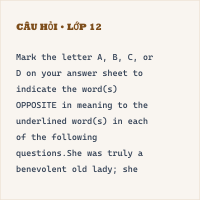
Mark the letter A, B, C, or D on your answer sheet to indicate the word(s) OPPOSITE in meaning to the underlined word(s) in each of the following questions.

She was truly a benevolent old lady; she even didn’t hurt an ant.

  • A.
    angry
  • B.
    kind
  • C.
    calm
  • D.
    cruel

Chưa có lời giải

Đã ẩn 50% câu hỏi phần đầu

Để xem các câu đã ẩn, lời giải hoặc đáp án, vui lòng bấm nút dưới đây.

Câu 22 (0.23đ)
Mark the letter A, B, C, or D on your answer sheet to indicate the word that differs from the other three in the position of the primary stress in each of the following questions
  • A.

    reconstruct

  • B.
    volunteer
  • C.
    understand
  • D.
    refurbish

Chưa có lời giải

Câu 23 (0.23đ)
Read the following passage and mark the letter A, B, C, or D on your answer sheet to choose the word or phrase that best fits each of the numbered blanks from 26 to 30.
Stepwells Unique to this region, stepwells are often architecturally complex and vary widely in size and shape. During their heyday, they were places of gathering, of leisure and relaxation and of worship for villagers of all but the lowest classes. Some were located in or near villages as public spaces for the community; (26) _______ were positioned beside roads as resting places for travellers. Down the centuries, thousands of wells were constructed throughout northwestern India, but the majority have now fallen into (27) _______ ; many are derelict and dry, as groundwater has been diverted for industrial use and the wells no longer reach the water table. (28) _______ , some important sites in Gujarat have recently undergone major restoration. Today, following years of neglect, many stepwells have been saved by the Archaeological Survey of India, (29) _______ has recognised the importance of preserving them as part of the country's rich history. Tourists flock to wells in far-flung corners of northwestern India to gaze in wonder at these architectural marvels from hundreds of years ago, which serve as a(n) (30) _______ of both the ingenuity and artistry of ancient civilisations and of the value of water to human existence. (Adapted from Cambridge English Academic IELTS 10 by Cambridge University Press)

Some were located in or near villages as public spaces for the community; (26) _______ were positioned beside roads as resting places for travellers

  • A.
    the other
  • B.
    most of
  • C.
    much
  • D.
    others

Chưa có lời giải

Câu 24 (0.23đ)

Read the following passage and mark the letter A, B, C, or D on your answer sheet to indicate the correct answer to each of the questions from 31 to 35.

Have you ever wondered where museums get the works and relics that they put on display? If the museum is sponsored by the government, then the relics were probably collected under special laws that protect historical treasures related to that country. However, not all museums are sponsored by the government. Sometimes a private collector decides to set up a museum so that the public can view the works or relics in his or her collection. Since the 1990s, more and more of these museums set up by private collectors have sprung up in China. Typically, these private museums are small, but they give visitors the chance to see works and relics not found anywhere else. Songtang Li is one such collector who has put part of his private collection on display for the public. In 2001, Li opened his museum in an old 18th century house in Beijing. The museum displays some of the best examples of Chinese folk art he has collected over his lifetime. Li began collecting folk art sculptures when he was young. Thus began Li’s lifetime hobby of visiting demolition sites and collecting pieces of sculpture or decorative architecture. Anything that he was allowed to take away would end up in his collection. In the late 1970s, China underwent major economic reforms. At that time, Beijing started widespread demolition and rebuilding across the city. According to Li, more than ninety percent of the old houses and temples in Beijing have since been torn down and replaced with modern buildings. Luckily, all of old Beijing’s architectural folk art has not been lost. Visitors to the Songtangzhai Folk Sculpture Museum can view some of the best relics Li rescued over the years. (Adapted from Reading Challenge 3 by Casey Malarcher and Andrea Janzen)

Which could be the best title for the passage?

  • A.
    China refused to change the face of museums.
  • B.
    From a childhood hobby to a career: Fail in the end.
  • C.
    Rescuing Relics.
  • D.
    All things have to be lost.

Chưa có lời giải

Câu 25 (0.23đ)

The apprentice will send a present to her boss _______ .

  • A.
    until he came back from his business trip
  • B.
    as soon as he comes back from his business trip
  • C.
    by the time he comes back from his business trip
  • D.
    while he was coming back from his business trip

Chưa có lời giải

Câu 26 (0.23đ)

Already 360 US papers – including most of the biggest and best – have built paywalls around its products.

  • A.
    including
  • B.
    most of
  • C.
    have built
  • D.
    its

Chưa có lời giải

Câu 27 (0.23đ)

Read the following passage and mark the letter A, B, C, or D on your answer sheet to indicate the correct answer to each of the questions from 31 to 35.

Have you ever wondered where museums get the works and relics that they put on display? If the museum is sponsored by the government, then the relics were probably collected under special laws that protect historical treasures related to that country. However, not all museums are sponsored by the government. Sometimes a private collector decides to set up a museum so that the public can view the works or relics in his or her collection. Since the 1990s, more and more of these museums set up by private collectors have sprung up in China. Typically, these private museums are small, but they give visitors the chance to see works and relics not found anywhere else. Songtang Li is one such collector who has put part of his private collection on display for the public. In 2001, Li opened his museum in an old 18th century house in Beijing. The museum displays some of the best examples of Chinese folk art he has collected over his lifetime. Li began collecting folk art sculptures when he was young. Thus began Li’s lifetime hobby of visiting demolition sites and collecting pieces of sculpture or decorative architecture. Anything that he was allowed to take away would end up in his collection. In the late 1970s, China underwent major economic reforms. At that time, Beijing started widespread demolition and rebuilding across the city. According to Li, more than ninety percent of the old houses and temples in Beijing have since been torn down and replaced with modern buildings. Luckily, all of old Beijing’s architectural folk art has not been lost. Visitors to the Songtangzhai Folk Sculpture Museum can view some of the best relics Li rescued over the years. (Adapted from Reading Challenge 3 by Casey Malarcher and Andrea Janzen)

Which could be the best title for the passage?

  • A.
    China refused to change the face of museums.
  • B.
    From a childhood hobby to a career: Fail in the end.
  • C.
    Rescuing Relics.
  • D.
    All things have to be lost.

Chưa có lời giải

Câu 28 (0.23đ)

Read the following passage and mark the letter A, B, C, or D on your answer sheet to indicate the correct answer to each of the questions from 31 to 35.

Have you ever wondered where museums get the works and relics that they put on display? If the museum is sponsored by the government, then the relics were probably collected under special laws that protect historical treasures related to that country. However, not all museums are sponsored by the government. Sometimes a private collector decides to set up a museum so that the public can view the works or relics in his or her collection. Since the 1990s, more and more of these museums set up by private collectors have sprung up in China. Typically, these private museums are small, but they give visitors the chance to see works and relics not found anywhere else. Songtang Li is one such collector who has put part of his private collection on display for the public. In 2001, Li opened his museum in an old 18th century house in Beijing. The museum displays some of the best examples of Chinese folk art he has collected over his lifetime. Li began collecting folk art sculptures when he was young. Thus began Li’s lifetime hobby of visiting demolition sites and collecting pieces of sculpture or decorative architecture. Anything that he was allowed to take away would end up in his collection. In the late 1970s, China underwent major economic reforms. At that time, Beijing started widespread demolition and rebuilding across the city. According to Li, more than ninety percent of the old houses and temples in Beijing have since been torn down and replaced with modern buildings. Luckily, all of old Beijing’s architectural folk art has not been lost. Visitors to the Songtangzhai Folk Sculpture Museum can view some of the best relics Li rescued over the years. (Adapted from Reading Challenge 3 by Casey Malarcher and Andrea Janzen)

Which could be the best title for the passage?

  • A.
    China refused to change the face of museums.
  • B.
    From a childhood hobby to a career: Fail in the end.
  • C.
    Rescuing Relics.
  • D.
    All things have to be lost.

Chưa có lời giải

Câu 29 (0.23đ)

Mark the letter A, B, C, or D on your answer sheet to indicate the correct answer to each of the following questions.

The patients _______ with the new drug showed better signs of recovery than those receiving conventional medicine.

  • A.
    treated
  • B.
    having treated
  • C.
    treating
  • D.
    who treated

Chưa có lời giải

Câu 30 (0.23đ)

His dream to become an interpreter was at last _______ .

  • A.
    caused
  • B.
    fulfilled
  • C.
    made
  • D.
    haunted

Chưa có lời giải

Câu 31 (0.23đ)

The country has vaccinated 70% of its population since the first vaccines _______ .

  • A.
    had been produced
  • B.
    have been produced
  • C.
    were produced
  • D.
    are produced

Chưa có lời giải

Câu 32 (0.23đ)

They're _______ free buses to and from the concert.

  • A.
    cheating on
  • B.
    laying on
  • C.
    relying on
  • D.
    counting on

Chưa có lời giải

Câu 33 (0.23đ)

Mark the letter A, B, C or D on your answer sheet to indicate the word whose underlined part differs from the other three in pronunciation in each of the following questions.

  • A.

    achieve

  • B.
    amend
  • C.
    answer
  • D.
    awake

Chưa có lời giải

Câu 34 (0.23đ)

“Why don’t you go with me to the Italian restaurant after work?” said Tim to Falla.

  • A.
    Tim warned Falla not to go with him to the Italian restaurant after work.
  • B.
    Tim asked Falla to go with him to the Italian restaurant after work.
  • C.
    Tim suggested that Falla go with him to the Italian restaurant after work.
  • D.
    Tim invited Falla not to go with him to the Italian restaurant after work.

Chưa có lời giải

Câu 35 (0.23đ)

Mark the letter A, B, C, or D on your answer sheet to indicate the sentence that best combines each pair of sentences in the following questions.

He doesn’t have any money left. He can’t buy lunch.

  • A.
    Unless he has any money left, he can buy lunch.
  • B.
    If he had some money left, he couldn’t buy lunch.
  • C.
    He wishes he had some money left and he could buy lunch.
  • D.
    He can buy lunch as long as he doesn’t have any money left.

Chưa có lời giải

Câu 36 (0.23đ)

When I came to the birthday party, all the guests _______ .

  • A.
    had already left
  • B.
    already left
  • C.
    leave
  • D.
    have left

Chưa có lời giải

Câu 37 (0.23đ)
Read the following passage and mark the letter A, B, C, or D on your answer sheet to choose the word or phrase that best fits each of the numbered blanks from 26 to 30.
Stepwells Unique to this region, stepwells are often architecturally complex and vary widely in size and shape. During their heyday, they were places of gathering, of leisure and relaxation and of worship for villagers of all but the lowest classes. Some were located in or near villages as public spaces for the community; (26) _______ were positioned beside roads as resting places for travellers. Down the centuries, thousands of wells were constructed throughout northwestern India, but the majority have now fallen into (27) _______ ; many are derelict and dry, as groundwater has been diverted for industrial use and the wells no longer reach the water table. (28) _______ , some important sites in Gujarat have recently undergone major restoration. Today, following years of neglect, many stepwells have been saved by the Archaeological Survey of India, (29) _______ has recognised the importance of preserving them as part of the country's rich history. Tourists flock to wells in far-flung corners of northwestern India to gaze in wonder at these architectural marvels from hundreds of years ago, which serve as a(n) (30) _______ of both the ingenuity and artistry of ancient civilisations and of the value of water to human existence. (Adapted from Cambridge English Academic IELTS 10 by Cambridge University Press)

Some were located in or near villages as public spaces for the community; (26) _______ were positioned beside roads as resting places for travellers

  • A.
    the other
  • B.
    most of
  • C.
    much
  • D.
    others

Chưa có lời giải

Câu 38 (0.23đ)

With greatly increased workloads, everyone is _______ pressure now.

  • A.
    under
  • B.
    out of
  • C.
    above
  • D.
    upon

Chưa có lời giải

Câu 39 (0.23đ)

Meredith sat at her desk _______ , carefully planning how to word her thesis proposal.

  • A.
    in the dark
  • B.
    in a brown study
  • C.
    on the dot
  • D.
    at the push of a button

Chưa có lời giải

Câu 40 (0.23đ)

Mark the letter A, B, C, or D on your answer sheet to indicate the underlined part that needs correction in each of the following questions.

Many distinguishable scholars agreed that the strategic decision the government had made to help curb the spread of the virus was unreasonable.

  • A.
    distinguishable
  • B.
    strategic
  • C.
    curb
  • D.
    unreasonable

Chưa có lời giải

Câu 41 (0.23đ)

Read the following passage and mark the letter A, B, C, or D on your answer sheet to indicate the correct answer to each of the questions from 31 to 35.

Have you ever wondered where museums get the works and relics that they put on display? If the museum is sponsored by the government, then the relics were probably collected under special laws that protect historical treasures related to that country. However, not all museums are sponsored by the government. Sometimes a private collector decides to set up a museum so that the public can view the works or relics in his or her collection. Since the 1990s, more and more of these museums set up by private collectors have sprung up in China. Typically, these private museums are small, but they give visitors the chance to see works and relics not found anywhere else. Songtang Li is one such collector who has put part of his private collection on display for the public. In 2001, Li opened his museum in an old 18th century house in Beijing. The museum displays some of the best examples of Chinese folk art he has collected over his lifetime. Li began collecting folk art sculptures when he was young. Thus began Li’s lifetime hobby of visiting demolition sites and collecting pieces of sculpture or decorative architecture. Anything that he was allowed to take away would end up in his collection. In the late 1970s, China underwent major economic reforms. At that time, Beijing started widespread demolition and rebuilding across the city. According to Li, more than ninety percent of the old houses and temples in Beijing have since been torn down and replaced with modern buildings. Luckily, all of old Beijing’s architectural folk art has not been lost. Visitors to the Songtangzhai Folk Sculpture Museum can view some of the best relics Li rescued over the years. (Adapted from Reading Challenge 3 by Casey Malarcher and Andrea Janzen)

Which could be the best title for the passage?

  • A.
    China refused to change the face of museums.
  • B.
    From a childhood hobby to a career: Fail in the end.
  • C.
    Rescuing Relics.
  • D.
    All things have to be lost.

Chưa có lời giải

Câu 42 (0.23đ)
Read the following passage and mark the letter A, B, C, or D on your answer sheet to choose the word or phrase that best fits each of the numbered blanks from 26 to 30.
Stepwells Unique to this region, stepwells are often architecturally complex and vary widely in size and shape. During their heyday, they were places of gathering, of leisure and relaxation and of worship for villagers of all but the lowest classes. Some were located in or near villages as public spaces for the community; (26) _______ were positioned beside roads as resting places for travellers. Down the centuries, thousands of wells were constructed throughout northwestern India, but the majority have now fallen into (27) _______ ; many are derelict and dry, as groundwater has been diverted for industrial use and the wells no longer reach the water table. (28) _______ , some important sites in Gujarat have recently undergone major restoration. Today, following years of neglect, many stepwells have been saved by the Archaeological Survey of India, (29) _______ has recognised the importance of preserving them as part of the country's rich history. Tourists flock to wells in far-flung corners of northwestern India to gaze in wonder at these architectural marvels from hundreds of years ago, which serve as a(n) (30) _______ of both the ingenuity and artistry of ancient civilisations and of the value of water to human existence. (Adapted from Cambridge English Academic IELTS 10 by Cambridge University Press)

Some were located in or near villages as public spaces for the community; (26) _______ were positioned beside roads as resting places for travellers

  • A.
    the other
  • B.
    most of
  • C.
    much
  • D.
    others

Chưa có lời giải

Câu 43 (0.34đ)

They encouraged the employees _______ the conference.

  • A.
    to attend
  • B.
    attending
  • C.
    attend
  • D.
    being attended

Chưa có lời giải